Saturday, 24 November 2012

Large and Little

As I was driving into Sandy Smith Nature Reserve (SSNR) this morning a Buzzard (Large) was sat on a post nearby (the other week it was on a post next to the road) but a surprise came a little further on in the form of a bird of prey (Little) sat on a fence. It let me stop the car, roll down my window and even reverse my car to get a better camera angle without flying away. It was all of about 2/3 metres away.


Above: Merlin at Sandy Smith Nature Reserve today (24/11/12).

Given that this bird did't fly away as soon as the car came near, I had to check that it was ok. On exiting the car it did fly away so yes, it was ok and it was definitely not plastic! Not wanting to disturb it any more and wanting to get on with my ringing session before the rain arrived, I carried on.

Todays ringing session produced 40 birds of which 13 were new and 27 retraps as follows:

Great Spotted Woodpecker 0 (1) - a new longevity record for the site at 1 year, 348 days.
Wren 1 (1)
Robin 0 (1)
Goldcrest 1 (0)
Long Tailed Tit 0 (2) - one being a new longevity record for the site at 2 years, 80 days.
Coal Tit 0 (2)
Blue Tit 4 (11)
Great Tit 0 (9)
Treecreeper 2 (0)
Chaffinch 2 (0)
Goldfinch 1 (0)
Lesser Redpoll 2 (0)

Above: One of 2 Treecreepers ringed at SSNR today (the 2nd & 3rd ringed at this site).


That is now 5 new Goldcrests for SSNR this year (none previously) and 24 Lesser Redpolls (including this Autumn (35 this year).
A ringing session at SSNR on 11th November produced 37 new and 27 retraps:


Wren 6 (0)
Dunnock 0 (2)
Robin 0 (1)
Blackcap 1 (0) - the first winter record for this species at SSNR.
Goldcrest 2 (0)
Long Tailed Tit 9 (7)
Blue Tit 8 (7)
Great Tit 4 (9)
Chaffinch 4 (1)
Lesser Redpoll 3 (0)

The notable bird here being a winter record of Blackcap. Again, more Goldcrests and more Lesser Redpolls. I need 186 more captures to beat last years total number of handlings. I may get 2 or 3 more sessions but I am unlikely to make it - I'll try though!
On the weekend between the 2 catches above, I went to Gloucester to see family. On the Sunday (18th Nov) I managed a ringing session at my Dad's house in the Cotswolds:

Dunnock 3 (2)

Blackbird 1 (1)
Blackcap 1 (0) - A new species for this site
Goldcrest 4 (0) - A new species for this site
Long Tailed Tit 7 (0)
Coal Tit 1 (0)
Blue Tit 13 (5)
Great Tit 1 (0)
House Sparrow 4 (0)

Given that I don't ring this site very often at all (my last session there was last Christmas), most retraps are likely to produce a longevity record for the site.
The retrap male Blackbird was first ringed 2 years, 285 days before its later recapture. I assume this is one of a ringed pair my dad regularly reports as coming to feed on the scraps he is always putting out for the birds.
One of the retrap Blue Tits was first ringed 2 years and 327 days previously (now the oldest record for the site).

Above: Male Blackcap - a good winter record at my Dad's house in the Cotswolds. I have seen Blackcap maybe once or twice before at his house in 20 years.

As ususal, I hope to be able to share more bird ringing news soon! Wish me luck... and dry weather!

Saturday, 10 November 2012

From dawn till dusk

Normally, I'm up at the crack of dawn to ring birds when they're at their most active. Today, the weather forecast predicted rain so I stayed in doing chores. Having found the card reader, I can now take the photographs off my camera and show you some of the birds I've caught when I've been up early.


Above: A Lesser Redpoll ringed at Priory Country Park. This bird had been ringed by another ringer on another site somewhere in Britain. I will post the original ringing details of this bird when it comes through (it may take a while!). This came out of the nets shortly after dawn and the lucky people who came to the guided bird walk on 28th October got to see this bird.

I've had a successful time catching this species both at Priory CP and Sandy Smith NR, having doubled the previous ringing totals for this species at both sites.


Above: A Woodpigeon ringed at Priory Country Park in September.


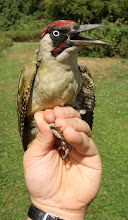
Above: I renewed my friendship with this Green Woodpecker, also in September. My first retrapping of this species at over 1 year since it was first ringed by me.


Above: A Goldcrest - a new species for Sandy Smith Nature Reserve ringing list.

As the days are shorter, I've been staying out most of the day with my ringing which has worked out nicely on occasion, particularly in catching Goldfinches at Proiry CP.


Above: The spectacular sunset over Bedford from Wednesday 7th November. And no, I wasn't driving, or cycling when taking this photograph (I was sat in the passenger seat). There have been several good sunsets recently and this leads me nicely onto dusk.

Dusk is a time when birds go to roost and lately my thoughts have been turning towards catching birds coming to roost. Having done some chores and desperate to get out ringing, myself and Mike put 4 nets around the outside of a reedbed roost produced the following (retraps in brackets):

Wren 2 (1)
Great Tit 0 (2)
Goldcrest 2 (2)
Blue Tit 4 (5)
Long Tailed Tit 0 (4)
Chiffchaff 1 (0)
Reed Bunting 5 (0)

And lastly one special bird, a species I haven't ringed before.


Above: A Corn Bunting.

The Corn Bunting is the species depicted on the Ivel Ringing Group logo so it's about time we started catching them again!

Saturday, 27 October 2012

Sunset at Sandy Smith Nature Reserve


I'm a week late in posting this, but this spectacular sunset at Sandy Smith Nature Reserve was observed and photographed last weekend (20th October).

Sunday, 7 October 2012

ABCDEFGHI KLMNOPQRSTUVWXYZ

I've been a bit quiet on the blogging front for a while. Sorry about that if you tune in regularly! There's been a few minor things to tell/show you, but I've been trying to rest (in between ringing sessions and working), plus I can't get the photographs of my SD card at the moment (will have to buy another SD card reader or get/find a cable!).

I've also been analysing data, making submissions and putting this years CES (scientific survey) at Priory Country Park into context - one of the worst in the last 20 years for total numbers of birds ringed/retrapped and many species have suffered, but not all and it probably seems worse than it actually is.

A brief mention of the weather - at the end of the day, I've still managed a lot of ringing sessions at the weekends inbetween downpours, with some highlights. One of these came yesterday:

Above: This photograph of a Jay ringed at Priory Country Park is courtesy of Dave Kramer.

Only the second Jay ringed at Priory Country Park. Probably one of many that are currently migrating across the country at the moment (though one can't be sure it isn't local, British or foreign as it didn't have a ring and it certainly didn't tell me!).

A Reed Warbler at Priory Country Park (also yesterday) was very late and represents the latest ever ringed at the site. Yesterday was a lovely day, very calm and pleasant. I almost forgot to mention the Woodpigeon I ringed last weekend and the Green Woodpecker I renewed acquantainces with (first ringed by me in 2011) - photographs in the camera!

Moving on to Sandy Smith Nature Reserve (SSNR), Whitethroats have been the biggest loser to the weather and numbers have crashed there this year. A bit of context though as last year appeared exceptionally good so they had a long way to fall! A new species was added to the site list last month in the form of one of our smallest birds - the Goldcrest. Of course, this is another of the photographs stuck on my camera for the moment. 2 were ringed last month on separate days.

A Chiffchaff ringed at SSNR has been recovered somewhere, I am told - we know not where, yet - but given the species, it has the potential to be an interesting movement.

Otherwise totals have been ticking over, as is time - the weekend is over and it's back to work!

Tuesday, 28 August 2012

Bird Bank

A bank holiday weekend full of birds was my hope. Apart from one net round on Sunday morning (14 birds) it wasn't exactly full, but there was enough to make it worthwhile.

Saturday and Monday were spent at Sandy Smith Nature Reserve and Sunday saw me fulfilling my commitment to complete 12 CES sessions at Priory Country Park.


Above: Lesser Whitethroat at Priory Country Park. Our first one ringed all year here, a juvenile.

The catch at Priory included a mini-influx of Blackcap - probably on the move along with the Lesser Whitethroat.

A ringing demo to the guided bird walk allowed us to demonstrate our craft to 5 lucky onlookers who saw a Long Tailed Tit and a Blackcap. They just missed the round with 14 birds but went away before we spent ages, and ages awaiting our next bird!


Above: Willow Warbler at Sandy Smith Nature Reserve.

I've caught a few Willow Warblers here recently (none at Priory Country Park as yet this year).

Reports of Winchat at SSNR earlier in the week had me wandering to find them. Saturday morning and first thing they weren't around but mid morning 2 appeared. House Martins on migration passed over. Monday morning and House Martins were again on the move and though I looked for the Winchat, I drew a blank. A couple of Linnets were a bonus.

Star bird of the bank holiday weekend was to be a bit of a surprise. The first one to be ringed at SSNR. During the winter I may have seen one (views weren't great and not enough to positively ID it) - not on the site, but very nearby. So it's been a possibility.

This is another bird record that will be deposited in my growing 'bird bank' (or IPMR to other ringers!).


Above & Below: A Nuthatch. At this time of year (after post juvenile moult & moult in the adult), we are unable to age these birds as there are no reliable differences in plumages.

For a second, I thought I'd caught a second one later on, but it wasn't to be (it was the same bird!). Hopefully next time it (and others of its kind) will make an appearance later in the year, and/or next.


"Cracking bird Gromit!"

Sunday, 29 July 2012

Seed thief identified!

For months I've been wondering which culprit has been stealing my seed from Sandy Smith Nature Reserve. I haven't been catching enough birds at each visit for them to be chomping through all the seed.

From the stripping of the bark on the tree, I thought it was probably a squirrel but I've never seen a squirrel near the feeders. More recently, the plot thickened and the seed was being knocked onto the floor and eaten from there.

In a ringing session today I met the juvenile delinquent responsible going by the first name of Jack, last name Daw! It received a standard ankle tag (ring) before it left. A first for me and the first ringed at SSNR. I think I can live with the extra expense for the seed now :o)

I did take a photo or two with my phone camera but in trying to work out how to get them off the phone, I've managed to lose them. They would have been grainy anyway!

Of note, I caught my first Willow Warbler of the year. A juvenile that has probably come from elsewhere and is on the move. 2 juvenile Coal Tits were a bonus. However, as a site known for its Whitethroats, today's catch did not include a single one. The adults I have caught in the last couple of weeks were moulting and I suspect they're going or have already departed on their journeys. The juveniles are few and far between too.


I compared 2011 and 2012 total catches of juveniles at both SSNR and Priory Country Park up to 22nd July. If you want to see the results visit the Ivel Ringing Group blog here.

Sunday, 1 July 2012

Sandy Smith NR - a new species ringed

I've been unable to visit Sandy Smith Nature Reserve much recently, largely due to the weather being miserable. More info about a visit on Tuesday 26th June can be found on the Ivel Ringing Group blog here. This ringing session brought the first juvenile Sedge Warblers, Whitethroats, Blue/Great Tits, Great Spotted Woodpecker and Chaffinches we also caught 2 Starlings (only the 2nd & 3rd ringed here) - a ringing tick for David.

A visit this morning (Sunday 1st) produced more new juveniles including the first juvenile Wren of the year here but was interesting in a different way. The last catch produced:


Above: A Kestrel - the second to be ringed at SSNR.

A single House Martin was the best bird. A first for the site and also a ringing tick for me. A group had been skimming around low down all morning long (including some Swallows) in the area.


Above: An adult House Martin. A female as it had a brood patch that appeared to be reducing (B3 on its way to B4).

These House Martins aren't usually to be found feeding like this on the reserve until later in the year so I am speculating that these have finished breeding (I don't know if there were any juveniles amongst the flock). This was an accidental catch as they are not normally caught in mist netting activities unless targeted. I was lucky one made a mistake - others flew over the top of the nets!

Tuesday, 5 June 2012

Birds of Extremadura, Spain VIII

This is the last installment of photographs of birds from Extremadura, Spain. Probably....!

Wandering around the countryside in the Grados mountains, we were following a track alongside a river hoping to find a Dipper (unsucessfully) and/or a Grey Wagtail (sucessfully). A couple of Golden Orioles were heard, but not seen, a Robin, Blackcap and Long Tailed Tits provided interest until this:


Above: A Rock Bunting (Escribano montesino). We only saw the one but had decent views of it for about a minute.


Above: An Otter (Nutria). Standing on a dam, looking across the panorama which had been graced by a Black Kite (see previous post for picture) and 2 Kingfishers, my feet were turning to walk back to the car when something on a rock caught my eye - this Otter. We watched it for about 10 minutes as it ate (2 meals), dived down, swam around and played in the water. 

We checked out several short sections of mountain river as we were passing in the car. On the last day it worked out and we found one. I also saw 2 Coal Tits at this location, completing the species seen list for the holiday.


Above: A Dipper (Mirlo acuático). 


Above: This is how a Dipper feeds -dipping under the water so as to be able to see its prey. It needs rocky streams and rivers where the water is shallow enough to stand in and 'dip.'
   

Above: A Crested Lark (Cogujada común). This species was the first 'never seen before' species for the holiday (a bird in a service station car park). The one in the photograph was seen near Trujillo and was collecting food for youngsters.


Above: The same Crested Lark hopping on the rocks. I thought by cropping the photograph in this way, it would make a good bookmark!


Above & below: A Hoopoe (Abubilla). Marvelous birds and very distinctive.


Many were seen throughout the holiday but this one, in Merida, kept on feeding as I approached - if I had got any closer, the whole bird wouldn't have fit into the frame!


I'm just really enjoying the idea of making bookmarks out of some of these photographs!

Sunday, 27 May 2012

Birds of Extremadura, Spain, VI


I took over 1000 photographs of birds in Spain, so rather unsurprisingly, I've still got more to share with you. Don't worry, I won't be posting 1000 photographs as most of them have been or will be deleted. Here is a mix species I saw less than a handful of times and a couple that were much more common.


Above: A Melodious Warbler (Zarcero común). This was my first time seeing this species and was glad I got a photograph as identification of warblers can be tricky.


Above: Another and very obliging Melodious Warbler (Zarcero común) at Saucedilla. I only saw these 2 during the whole holiday.


Above: A Black-Kite (Milano negro). This species was very common across the region, by far outnumbering Red Kites (Milano real). One day, driving past a house/farm near Trujillo with goats in the back yard, I counted more than 20 circling very low down - perhaps they were waiting for a goat to keel over!


Above: A Black-winged Kite (Elanio azul). Definitely on the 'must see' list. I was very happy when, whilst driving along, I shouted "Black-winged kite, STOP THE CAR!" Two were on a telegraph pole & line.

On the second to last day, we saw another near Saucedilla. Observing it, I noticed it can hover almost like a kestrel and it has a glide resembling that of a harrier.


Above: Azure-winged Magpie (Rabilargo). These were very common across the region. A highly mobile species that always stayed at a distance.


Above: Booted Eagle (Águila calzada). The lighting wasn't good but inbetween rain showers, this bird flew past us. If you look at the photograph carefully, you will see the diagnostic white patches (also known as 'landing lights') either side of the neck. Only 2 or 3 were seen during the holiday.

Before going to Spain, I read a couple of reports that said migration and bird numbers were significantly down compared to normal, strong winds and unfavourable wind directions meaning migratory birds were being held up or being diverted elsewhere. Since coming back, I spoke to someone who was there at the same time as me (and who had been 3 years previously) and he confirmed numbers were significantly down. I certainly can't complain as it was fantastic to see over 100 species, a quarter of which I'd not seen before. I may return in future and if it's a good year, it should be well worth going again!

Sunday, 20 May 2012

Birds of Extremadura, Spain V

Another post, another dose of birds from Spain. As usual, the Spanish names for the birds are in brackets.


Above: Collared Pratincole (Canastera). We were told a road going west from Campo Lugar would be good for bird species. Upon arrival we met Spanish Birder - Antonio Calvo. My dad being fluent in Spanish got talking to him and soon he was showing us where to see the Collared Pratincoles on the ground.

Apparently they like ploughed, fallow fields. Not really knowing where we were or weren't allowed to stray off the roads to view birds, it was nice to have somebody who knew.


Above: A flock of about 50 Collared Pratincoles. I'd already seen a couple of singles and probably the same flock as above and suspected they were Collared Pratincoles but with Antonio's help, we got good views.

Whilst watching the Pratincoles, a nice adult male Montagu's Harrier passed through - the second and last one we saw during the holiday. I was too slow with the camera to get anything in focus.


Above: Great Bustard (Avutarda). Unfortunately, Antonio was only able to get us very distant views (ruined by heat haze) of this species, other than 2 birds in flight. It has been a bad year for birds in Extremadura with droughts lasting 2 years and much much reduced numbers of birds on migration. It has been hard to find even the resident species in great numbers. Antonio will be greatly relieved to know shorly after leaving him, we found this individual.

Antonio is starting his own accomodation/bird guide business. For those of you who can speak Spanish and would like some eco-friendly (walking) bird tours of Extremadura, visit his web site http://www.elelanio.com/ (you can read in Spanish or English).


Above & below: Gull-billed Tern (Pagaza piconegra). I find some Tern species difficult to distinguish between - especially at a distance. However, this Gull-billed Tern came quite close whilst I was standing on a bridge and you can see from the photograph it is has an all black bill (short & stout) and a black bar along the ends of the primary feathers - these are the identification features. It's call - remarkably non-tern like also gave it away.

This was a species on the 'want to see' list for the holiday and if it weren't for this one stop at the bridge I wouldn't have been able to say I'd seen one. I'd seen 4 Tern's previously at Merida but too distant to ID.


We went to many lakes/reservoirs in Extremadura but found very little in the way of water birds (e.g. ducks etc.). They can be awash with birds during the winter and very worth visiting, but apparently not during the spring/summer. More interest came from the surrounding habitat (although there were very few reed beds at all).


Above: Black Wheatear (Collalba negra). Not being able to get close enough for a good photograph (it consistantly stayed out of range for a good photo - normal behaviour I'm told!) I was delighted with being able to add it to the seen list.