Sunday, 22 May 2011

Sardinia Birds 3

This will be the last update on Sardinia Birds (for this year!).


Above & Below: Zitting Cisticola (Fan-Tailed Warbler).


I saw these in Menorca last year but never got a good view. The two phographs above were taken on the last day where we visited the salt pans virtually next to the airport. It was well worth the visit and at one point, a Zitting Cisticola was so close I couldn't focus the telescope on it. I found them in the long grass along a fence line and the second photograph was taken as I was observing it moving in and out of the cut grass left on the ground looking for food.


Above: Slender Billed Gull

Having not connected with this species anywhere else in Sardinia (not that we tried specifically), we had read that this species was to be found at the same salt pans. This bird was not overly bothered by our presence and was the only one I saw - if only some of the other birds I saw would pose long enough for a photograph!

Unfortunately, I was not confident of my ID but I am fairly sure we saw a Black Kite here too.


Above: Kentish Plover. Beaches with sand dunes was where I found many of these (including 8 on one beach). Photographing them can only be at distance as they scurry away if you get anywhere near them! I also saw a few at different salt pans (also where I saw one in Menorca).


Above: This Curlew Sandpiper was on this pool on the same beach as the 8 Kentish plovers. The fading light wasn't good for great photographs though.


Above: Winchat. Probably the best photograph of the holiday.


Above: Horned (Shore) Lark. I left probably the second best bird (and the most unexpected) until last.

Walking along, a bird flew from the rocky shore to my left, across the very small headland to the other side. In a situation where any bird I find could turn out to be interesting or something I've never seen before, I'd have been annoyed with myself had I not checked out what it was. Once I'd seen it in the scope, I said "Dad, we're definitely interested in this bird!" The very obliging bird posed for quite a while in the end. Not sure if these are resident or passage migrants in Sardinia or very rare. Collins bird guide suggests this might be a rare record. I certainly didn't read anything before going suggesting you could see this speceis here.

I should do something to try and find out ...

Sardinia birds 2

There are a lot of suitable sites to watch birds in Sardinia but you have to travel to get a wide range of species. And travel takes time in Sardinia. We could only find 1 to 200000 scale maps (OS maps are 1 to 25000 in the UK) and these weren't that helpful by not showing all the roads!

When the map indicated that the route we wanted to take was going straight on through a town, we often found that due to chaotic one way systems, the actual route was far from straight forward. The lack of signs at major junctions was also not very helpful. And I don't recommend short cuts as you'll soon find yourself lost!

Wildlife tourism here is possible, it's just that signage, directions in literature and information are often hard to come by. Knowing enough Italian to ask for directions & understand them is essential!

Species such as Spanish Sparrow and Hooded Crow were very easy. But Crag Martin and Citril Finch took some travelling to find (slow going up & down those mountain roads) although this may have been just a result of the places we chose to travel to!


Above: A Woodchat Shrike.


Above: Spotted Flycatcher. Whilst sitting in the picnic/cafe area of a 'cultural location', a pair of Spotted Flycatchers were flitting around very close by. It was rude not to take a photograph!


Above: A Wheatear. I only saw this species above the tree line whilst walking up to the top of the highest mountain in Sardinia.


Above: Citril Finch. Again, only recorded above the tree line whilst walking up to the top of the highest mountain in Sardinia. It took us a long time to drive there, but once parked, it took only a minute to find these small finches.


Above: Funny story - the first species I saw on the holiday was a Starling. The plane had been on the ground less than a minute! But it was bothering me for several days. I kept on seeing Starlings but in my mind, I was questioning this ID. "They're a bit black" I was saying to myself. "They can't be blackbirds can they? No, I'm sure they're Starlings." But I'd not seen them up close because when I saw them, I/we were driving and they were at a distance. Anyway, when I finally looked up Starling in the book I found there was such a thing as Spotless Starling! My mind was easier but it still took a day or two to 'spot' one and confirm their spotlessness. The photograph (above) doesn't really show it very well.


Above: Hooded Crow. My holiday was punctuated with many shouts of 'what's that Edward?' My standard reply was - another Hooded Crow dad!


Above: Jackdaw. Whilst the hooded crow was common, this was only one of 2 Jackdaws seen (the other being at the same time as this one). The Hooded Crow (pictured above) and this Jackdaw were vying for position on the telegraph pole.


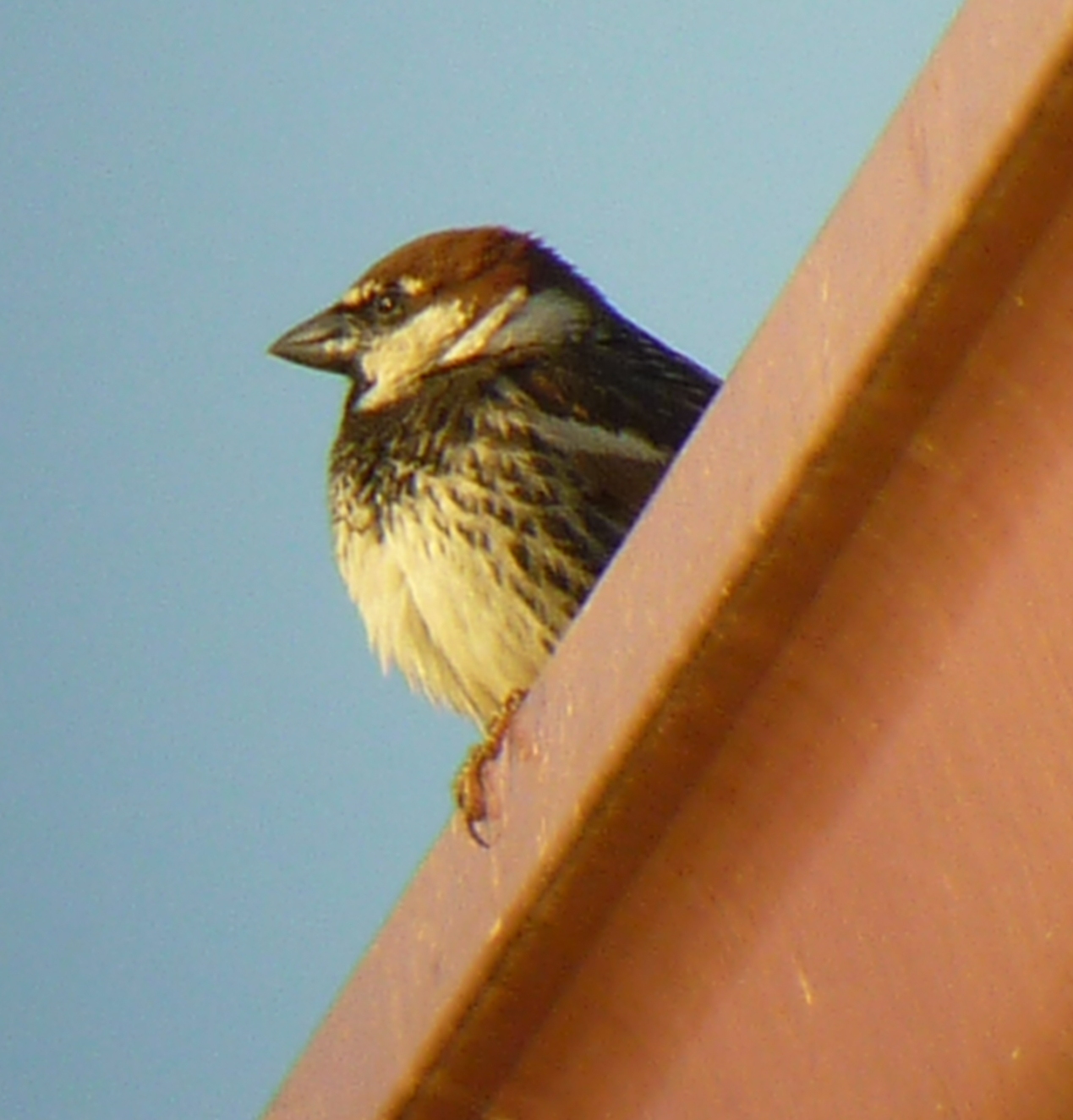
Above: Spanish Sparrow - this bird was one of many nesting in the roof of our hotel. They were everywhere and were by far the most recorded species on the holiday.

More to come yet!

Sardinian Birds 1

A recent holiday to Sardinia (South West) and I clocked up 76 species of bird, 14 of which I'd never seen before.

1. Spotless Starling
2. Little Egret
3. Swift
4. House Martin
5. Swallow
6. Hooded Crow
7. Kestrel
8. Corn Bunting
9. Spanish Sparrow
10. Stonechat
11. Greenfinch
12. Collared Dove
13. Dunlin
14. Sanderling
15. Alpine Swift
16. Kentish Plover
17. Goldfinch
18. Rock Dove
19. Sardinian Warbler
20. Great Tit
21. Cetti's Warbler
22. Blackbird
23. Spotted Flycatcher
24. Yellow legged gull
25. Black winged stilt
26. Avocet
27. Osprey
28. Turtle Dove
29. Shellduck
30. Ringed Plover
31. Shag
32. Common Tern
33. Greater Flamingo
34. Moorhen
35. Purple Heron
36. Hoopoe
37. Jay
38. Buzzard
39. Linnet
40. Marsh Harrier
41. Bee Eater
42. Woodchat Shrike
43. Grey Wagtail
44. Mallard
45. Robin
46. Coot
47. Little Grebe
48. Cuckoo
49. Blackcap
50. Cirl Bunting
51. Serin
52. Raven
53. Crag Martin
54. Little Tern
55. Curlew Sandpiper
56. Audouin's Gull
57. Moustached Warbler
58. Blue Rock Thrust
59. Eleanora's Falcon
60. Red Kite
61. Great Spotted Woodpecker
62. Jackdaw
63. Pied Flycatcher
64. Woodlark
65. Citril Finch
66. Skylark
67. Chaffinch
68. Winchat
69. Little Ringed Plover
70. Horned (Shore) Lark
71. Barbary partridge
72. Whitethroat
73. Bar-tailed Godwit
74. Cattle Egret
75. Slender Billed Gull
76. Zitting Cisticola (Fan Tailed Warbler)


Above: A Dunlin. Excellent close up views of Dulin and Sanderling were found on the beach (they prefered the small rocky outcrops in the shallow water).


Above: A Sanderling


Above: Greater Flamingo. Views of these birds were at distance only. I recorded them at two locations.


Above: A Serin. Whilst looking for a 'yellow bird' I didn't recognise, my dad called me over, saying 'Edward, look at this, what's this?' - a regular occurance but on this occasion it produced a pine marten! I was unable to get a photo because it moved too quickly. I never did locate that 'yellow bird' but shortly after and before we drove away, I located my first ever Cirl Bunting that flew away shortly before I got the camera ready to take a photo. Typical!

However, we were trying to locate a WWF reserve (I didn't know they did reserves) called Monte Arcuso. Shortly after arriving here I did locate a 'yellow bird' that proved to be the above Serin. Having located one, I found it easier to see more and they seem to be quite common in Sardinia. There was one on the hotel grounds. Their song is a bit like the Corn Bunting 'jangle' but they don't finish the 'jangle' with the same flourish.


Above: Dung beetles. Monte Arcuso has a stunningly beuatiful landscape, deep ravines and high mountains with challenging walks (especially whilst carrying telescope, binoculars and camera!). Plenty of cliffs. Here I also identified my first ever Crag Martins.


Above: Best bird of the holiday - Eleanora's Falcon. I saw 6 of these very rare breeding birds in one field of view in my binoculars. The photograph is a snapshot of a digiscope video I took. We spent a lovely 2 hours watching these birds hunt and play in the wind on the island of St. Pietro. I will never be sure, but it is possible that I saw an Orphean Warbler whilst sitting & wathcing the Eleanora's but I didn't get enough of a view to confirm.

There will be more to come!

Brothers, past and present


Above: The Blue Brothers (Mark is on the right)


Above: I'm on the left, Mark is on the right. This was taken in our back garden in Hutton Rudby, North Yorks.


Above: Eerie!


Above: Sleepy boys!

Monday, 2 May 2011

Constant Effort visit 1 - Priory Country Park

Sunday 1st May was the start of the CES season - it was sunny all morning. Chilly first thing with the wind picking up intensity throughout the morning probably resulting in a reduced catch in the second half.

18 birds of 12 species: New (retrap)

Bullfinch 3 (0)
Cetti's Warbler 0 (1)
Dunnock 2 (0)
Wren 0 (1)
Whitethroat 1 (0)
Reed Warbler 1 (0)
Blackbird 0 (2)
Garden Warbler 1 (1)
Goldfinch 1 (0)
Blue Tit 0 (1)
Chiff Chaff 2 (0)
Blackcap 1 (0)

Interesting info on some of these birds:

1 female Blackbird was born in 2008.
1 male Blackbird was born 2007 (first caught in 2008)
1 returning male Garden Warbler was ringed as an adult in 2010
The female Bullfinch's have well developed brood patch's
A male Blackcap with a false brood patch.


Above: A male Blackcap


Above: A Chiff Chaff


Above: Cetti's Warbler

A ringing demonstration was held for the 'Dawn Chorus' Walkers who were treated to close up views of the Cetti's Warbler (first ringed in April in the park).

Friday, 22 April 2011

What a good friday!

It ended up being a very hot day but it started off quite cool and very still. Today was all about migrants. Whitethroats have been around for at least a week, Sedge Warblers have started arriving, more Grasshopper Warblers, Chiff Chaff's are singing away. Add in a few locals and that would complete my day's ringing at Sandy Smith Nature Reserve.


Above: This Grasshopper Warbler was the last bird caught.


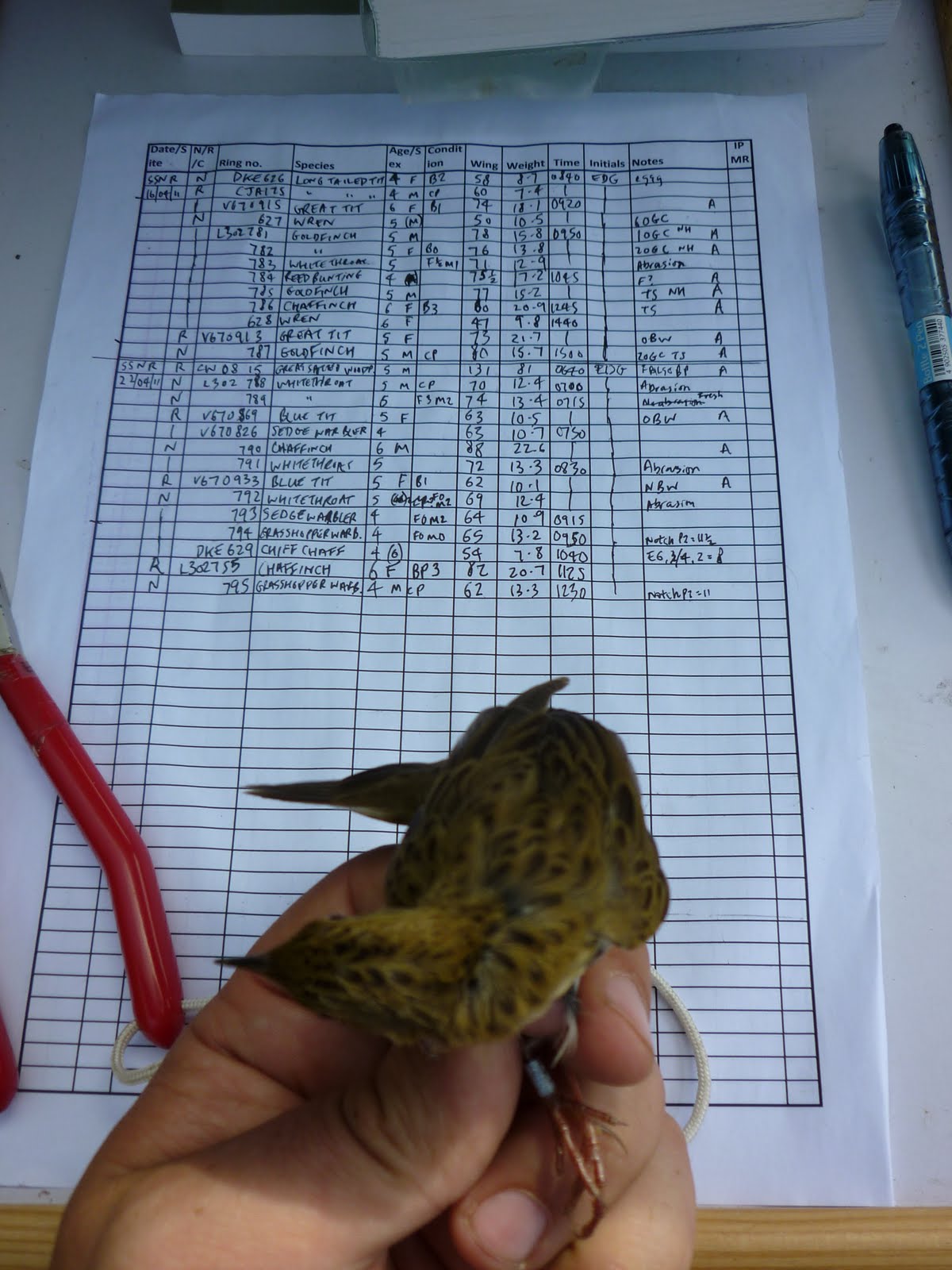
Above: A Grasshopper Warbler. 2 were ringed today - these being the 3rd and 4th ringed on site since I started ringing there a year ago.

The 'groppers' were singing all morning with at least 3 males around the ringing area.


Above: A Sedge Warbler - arrived between visits. One was a recapture from last year - 10/06/10. I know it has probably travelled a few thousand miles since first ringed but where has it been?


Above: A male Great Spotted Woodpecker with a false Brood Patch (obviously this modern male is helping out with the incubation duties!).


Above: A Chiff Chaff

In order of appearance: 14 birds of 7 species (retraps in brackets):

Great Spotted Woodpecker 0 (1)
Whitethroat 4 (0)
Blue Tit 0 (2)
Sedge Warbler 1 (1)
Chaffinch 1 (1)
Grasshopper Warbler 2 (0)
Chiff Chaff 1 (0)

A Cuckoo was heard briefly early morning & mid morning. A Jay was heard too. A female Mallard was on the river with 7 ducklings and 2 hares were seen.

I couple of impromptu 'ringing demonstrations' were held and I explained why we ring to a group of birders who came by, unfortunately whilst there were no birds. Sadly, all but me missed the ringing Grasshopper Warblers!

Sunday, 17 April 2011

Titchfield Haven

To add to my Southampton adventures, on Wednesday my brother, Claire and myself went to Titchfield Haven.


Above & below: I couldn't get a decent digiscoped image of an Avocet so here's two thanks to my brother.


Below: A digiscoped image of a Teal.

Tuesday, 12 April 2011

Southampton

End of financial year at work and I finally get some well deserved rest (well at least I think so). I decided on a visit to Southampton to see my brother and his wife and here is some of what we got up to:

Saturday afternoon we set out for a camp site in the New Forest.


Above: Claire in Rollie (the camper van) - the adventure begins!

Saturday evening we ate expensive but tasty food at the nearby pub.


Above: Mark & Claire at The Three Tons

Sunday morning was spent lounging around in the sun.


Above: Me doing the crossword.

Sunday afternoon we went to Mudeford - an interesting place full of beach huts out on a limb. We could only get there by foot or road train (we chose to put one foot in front of the other several thousand times).


Above: Mudeford beach huts.


Above: My SIL with her BIL (Sister/Brother-in-law!).

On this walk we saw a few Swallows, Sand Martins, Meadow Pipits, Godwits, Shelduck, Little Egret, Oystercathers, Dunlin and Redshank.

Then we came back home, ate a Roast tea and played a computer quiz game that called me slow...

Monday morning and I set out on a bike ride north from Southampton on the cyclepath/footpath alongside the River Itchin. According to local legend, you're not supposed to go swimming in the Itchin because you come out a Scratchin'!

An hour later when I was supposed to be turning round and going back for lunch, and no longer in the area that the OS map shows, I decided to find out where I was near to. 5 minutes later after a change of direction (off the footpath and onto the road) I found a village and a sign saying Winchester was only 4.1 miles away. Decision made, I was going to have lunch in Winchester.

Ate a nice meal in the Slug & Lettuce, did some shopping and cycled back. I showered, changed and was shuffled out the door to visit Lakeside Country Park in Eastleigh:


Above: Mallard ducklings - my first of the year. Presumably this brood has already been depleted from the original number hatched.


Above: My little brother finally learning to run after 30 years!


Above: Me pulling the strings on a stunt kite.

Liverpool beat Man City 3-0 in the Monday night match that we watched at the pub. Good result.

This morning was a bit lazy but we went to Keyhaven Salt Marshes with a picnic for lunch and an afternoon stroll around the 4km walk.


Above: A Turnstone. A digiscoped image (Opticron scope, Panasonic camera). I'm rather pleased with this one.


Above: Spot the 3 Turnstones. Taken by my brother on his Nikon and zoom lens.


Above: Me with my scope.

I'm going back to Bedford tomorrow before I get maimed by my SIL for telling one to many jokes and/or puns!

Saturday, 19 March 2011

Lesser vs Common Redpoll

A ringing session with Mark Thomas last weekend. We caught and I got to ring a new species for me, Common Redpoll.


Above: Common Redpoll.

A comparison between the two birds - the Common Redpoll (aka Mealy) is a lighter and greyer colour and is a larger bird than the darker and browner Lesser Redpoll.

Below: Lesser Redpoll.

New species for SSNR

3 ringing sessions at Sandy Smith Nature Reserve (SSNR) and 3 new species caught.

Session 1: 05/03/11

Totals: 15 birds of 8 species (retraps in brackets)

Coal Tit 1
Great Tit 1 (1)
Blue Tit 2 (1)
Dunnock 1
Chaffinch 2
Long Tailed Tit 1 (3)
Siskin 1
Marsh Tit 1

Having speculated recently that the flocks of Long Tailed Tit's in the area had moved (a new one came in and no evidence of catching any from previous flocks caught & ringed last year), the retrapped Long Tailed Tits in this session came from flocks caught & ringed last year. Speculation proved wrong then!


Above: I had been thinking about the possibility of catching a Marsh Tit here earlier in the morning but had come to the 'highly unlikely' conclusion. Then one arrived in the net!


Above: The new red 'motorway' at SSNR. It's a cycle path really but an odd way of doing it - perhaps it was a case of saving time and/or money as the two sides are uneven & follow the contours already there from vehicle rutting.

Session 2: 12/03/11

Totals: 10 birds of 4 species (retraps in brackets)

Goldfinch 6
Blue Tit 1 (1)
Chaffinch 1
Wren 1

Session 3: 18/03/11

Totals: 15 birds of 7 species (retraps in brackets)

Coal Tit 1
Siskin 1
Goldfinch 2
Chaffinch 5 (1)
Lesser Redpoll 1
Blue Tit 0 (3)
Reed Bunting 1


Above: I'd mentioned to MT the previous weekend that despite there being a lot of Siskin on site, there was no sign of any Redpolls. Then this turned up yesterday! However, from the behaviour (I saw it before catching it) I think it was moving through.


Above: Front view of this Lesser Redpoll. The pointed tail indicates that this bird was born last year (2010).


Above: A surprise in the net, this male Reed Bunting.