Tuesday, 15 May 2012

Birds of Extremadura, Spain IV

It's another day and I've got more photographs from Extremadura to show you. 


Above: White Stork nests - I don't know how the lower one has managed to stay there! Apparently, it is unusual to find them nesting on rocks like this as they normally can be found on chimneys and other man made structures (pylons for example). Unfortunately we missed out on Black Stork.


Above: A Griffon Vulture. We visited Monfrague National Park where there was a breeding colony of close to 100 pairs!


Above: Those of you who are eagle eyed may be able to see an owl chick on the ledge - a second one is tucked just behind the other. We waited about an hour to see if the adult Eagle Owl would show itself, but alas no.

We did see Blue Rock Thrush here, Red-rumped Swallow (see previous post for photograph), Blackcap, Crag Martin and a pair of Black Redstarts.


Above: A Spotless Starling.


Above: The Sardinian Warbler is a classic skulker - I tried hard to get photographs but they were always mobile and behind a lot of vegetation. This was the best shot.


Above: A Serin. I found these to be quite common around extremadura and I found that their 'jangling' song is very much like the Corn Bunting.


Above: Another common species to be found was Stonechat. I saw several juveniles of this species (as pictured).

Saturday, 12 May 2012

Birds of Extremadura, Spain III

I could not keep you in suspense for long, so without delay here are some of the more 'exotic' species I saw in Extremadura.


Above: A Cattle Egret (Garcilla bueyera). We were wandering around a park in Merida located on an island in the river not very far at all from the town centre. Although I couldn't get really close to them before they moved away, I knew I would regret it if I didn't take a photograph!


Above: See all those white dots in the trees? Click on the photograph to enlarge, count them (c. 50 I make it) - what are they? Mostly Cattle Egrets (Garcilla bueyera) with some Little Egrets (Garceta común) - again on an isolated island in the middle of the river at Merida. This is just one photograph of the nesting colony and I took several of different areas - there must have been 100's of Egrets there.


Above: A Purple Swamphen (Calamón común). We couldn't connect with this species at first, but with persistance I found a pair (with 2 chicks) in Merida. Moorhen and coot were more common. One species I was supposed to be able to see in Merida was the Penduline Tit. Apparently they are more likely to be seen when it is not windy - either they weren't there or it was too windy as I didn't see one. I'll have to wait until another time now.


Above: A Great White Egret (Garceta grande). The long protruding legs and yellow beak make this all white egret a great one!


Above: A Little Bittern (Avetorillo común). It gave frustratingly short views (again in Merida) as it skulks around the reeds most of the time, but it popped out, flew to a different area of reeds for long enough to get a few photographs before dissapearing quickly. Having not seen one before, it was definitely high on the 'to see' priority list. Definitely a highlight of the holiday.


Above: A Grey Heron (Garza real). Ok, so not so exotic but nice to compare to the heron in the photograph below:


Above: A Purple Heron (Garza imperial). Have seen them before - this was the best photograph I've managed so far.

Thursday, 10 May 2012

Birds of Extremadura, Spain II

As I was saying in my last post, about a quarter of the species I saw on the holiday were new to me. I hadn't done much research on what to expect as I like seeing them unexpectedly. I saw some species I had expected to, missed others and found some unexpected - a good mix. Again, it is worth clicking on the photographs to see them in higher resolution.

Having whetted your appetite in my previous post I take great delight in posting more photographs of the species I saw on holiday...

Above: A Jackdaw (Grajilla).


Above: A Goldfinch (Jilguero).

Birds in trees are a particularly difficult subject to photograph. The main problems being light and interfering vegetation. Not to mention distance. This one came out well - many didn't. The contrast of vegetation, sky, branches and the bird provides interest.


Above: A female Chaffinch (Pinzón del Hierro).


Above: A nice find and the only one I saw on holiday - a Nuthatch (Trepador azul).


Above: The countryside all around Extremadura was literally dripping with Corn Buntings (Triguero) like the one here. They were jangling from almost every fence post, bush and prominent position available! Driving along, I could hear them from inside the moving car!

Green 'the elder' kept on asking what I'd seen. Corn Bunting was a standard response! They were second only to House Sparrows as the most often seen on the holiday. Juding by my experiences of Southern Europe over my last few Holidays, I would postulate that Sparrows in Sardina, Menorca and Spain have not undergone the same kind of decline as we have seen in Britain over recent decades.

FYI, the great delight I took in posting more photographs was taken in not posting photographs of the more 'exotic' species! Those of you who know me better will not be surprised! You also won't be surprised to find that I will be kinder next time... maybe...!

Tuesday, 8 May 2012

Birds from Extremadura, Spain


Having had problems with my internet connection, I have been unable to post any of my photographs taken on a recent holiday to Extremadura, Spain. Though I have been able to edit them in preparation. The situation has improved... slightly... so here you go (do click on the photographs to see larger versions & the species names below are also given in Spanish for Antonio Calvo):


Above: A party of House Martins (Avíon común) collecting mud for their nest building. This species is common in Spain. There were many places where I found them and there were large colonies - under bridges/dams especially. One very long bridge had hundreds of nests under various stages of constant construction - on both sides!


Above: Gulp! A swallow, but not the Barn Swallow type that we see in Britain regularly during the spring/summer but a Red-rumped swallow (Golondrina daurica). N.B. Britain sees a handfull of the red-rumped type each year. Smaller than a Barn Swallow, the red/white rump and the red neck also make this bird stand out. This bird was photographed at Monfrague National Park.

Not too widespread but not too hard to find in Extremadura.


Above: Up the crag without a paddle? Well these Crag Martins (Avíon roquero) seemed to be doing ok! Presumably taking a rest from feeding (they weren't nesting on this ledge), I was able to get fairly close from a bridge above them. I saw some in Sardinia last year but I got better views this time!


Above: Having now seen these photographs up close, I am struck by how similar they are to swifts (in their wing feathers and beak structure), at least sitting - they look different in flight. They are built for catching insects on the wing.

The holiday itself was good. Though you won't want to hear it, the weather was better in Spain than in the UK! It did rain quite a bit towards the end (snow on the top of the mountains) but overall we did well. Over 100 species were seen and about a quarter were species I'd never seen before.

For those of you who might be interested, the bird photographs from Spain posted here (and in future posts) will have been taken with a Cannon EOS 1000D and a Cannon EF 400mm 1:5.6L lens.

Wednesday, 2 May 2012

Tapas!

A little taster of some of the photographs I took of Spanish birds from my recent trip there (Extremadura).
Above: A Swallow - one of the parents of the juvenile below.
Above: A Juvenile Swallow, begging for food from the nearby parents. It is warmer in Spain at this time of year and some migrant species will no doubt arrive in Spain before they do in Britain, though I was surprised to find a fledged juvenile Swallow so early (20th April). Other swallows I had seen were still nest building! It may take a while to organise the photographs and post them especially as the phone/internet at home are down at the moment. Most of the photographs to come aren't as clear as these, but you will get to see a range of more exciting species. I'm not giving you any clues yet though!

Wednesday, 18 April 2012

Going away...

I'm off on travels on Thursday. Hoping for some decent birds and great photographs from a trip to Extremadura (Spain) - some of which I will share with you in May.

When I get back, it will be straight back into work and then the CES ringing season starts.

Recent ringing has seen me at Priory Country Park - a pre CES session producing 27 birds including Dunnock, Wren, Blue Tit, Great Tit Chaffinch, Blackbird, Chiff Chaff (4) and Blackcap (8). One Blackcap was a male bird first ringed here last year on 20th July.

It has been slow at Sandy Smith Nature Reserve with catches of 8, 7 and 4. The Magpie you will have seen a picture of in a previous post. Otherwise, last weekend (15th) I was hoping for but didn't get the first Whitethroats and Grasshopper Warblers as they were both present on the 16th April last year. The weather has been different this year though and is apparently delaying the arrival of some species.

Other recent news is of a Goldcrest control trapped on 17th Dec at PCP - it was first ringed on 10/09/11, at Flamborough Head, East Yorkshire! 98 days, 221km south.
Nice one!

Friday, 6 April 2012

Something to Pica pica your interests!

Earlier in the year, one Pica pica got away at Sandy Smith Nature Reserve. Not so this time and this bird is the latest addition to the species ringed list for the site (the 6th added this year so far and the 40th in total).


Above: Magpie (Pica pica).

I can't really remember how it started but I always want to call them Eipgam's or variations thereof. I guess it's my mind working away in a backwards way.

There isn't anything else to report from the ringing totals (low numbers but two retrap Great Spotted Woodpeckers). A check of what else was around produced a sighting of 2 wheatears in the big sheep field.

Wednesday, 4 April 2012

Spring Migration

Spring migration for birds in 2012 is definitely underway. The first Chiff Chaff's started appearing 2-3 weeks ago and Blackcaps are moving through. In the last couple of days, Willow Warblers have started arriving (though as yet I haven't ringed this species this year). Large numbers of more species will arrive in the next month and I hope to catch up with Grasshopper Warblers and Whitethroat (at SSNR) before going on holiday towards the end of April.


Above: A Male Blackcap


Above: A female Blackcap - out of 10 ringed at Priory Country Park in the last 2 weekends, only 1 (this one) has been female. Several were carrying fat suggesting they haven't finished their migration yet.

A few Chiff Chaff's have also been trapped, including one ringed at Priory CP last year.

Reed Buntings are not one of the species you would immediately associate with spring, but in March Reed Buntings make their appearance at feeding stations. I first noticed this last year at Sandy Smith Nature Reserve (SSNR) as in March and April this species was caught in the feeding station net rides whilst for the rest of the year they were absent from this area. I have read reports of Reed Buntings found at Garden feeders during this time also. The same occured this year at SSNR and at Priory Country Park (PCP).


Above: This pair of Reed Buntings were ringed at SSNR.

Tonight I recieved confirmation that a Blue Tit (ring no. Y230511) caught at Priory Country Park on 7th Sept 2011 was originally ringed at Willington, Bedfordshire on 3rd July 2011, 66 days earlier, 3km away (west). Originally caught by MT, I may even have attended this ringing session! This isn't a significant movement but it was the first of 3 birds I have now caught with somebody else's ring on. Here's hoping for more!

There's not been a great deal else to report except for a Ringing Demo held at Priory Country Park on the last Sunday of March where we were lucky enough to demo a Treecreeper, Great Spotted Woodpecker and the first Blackcap of the year on a foggy morning (it didn't start that way!).

Tuesday, 28 February 2012

A rare day!

Ringing at Sandy Smith Nature Reserve this year has been interesting to say the least. Several new species for the site have been ringed (Starling, Brambling, Mistle Thrush). Of these, I am told the Brambling is currently the only known record of this species in Bedfordshire this year so far. Lesser Redpolls have been coming to the feeders, Siskin numbers are way down on last year and the first bird ringed elsewhere (Chaffinch) has been caught at SSNR.

So today I took a day off work and decided to add more chapters to this short story and today's chapter is a rare one!

Numbers wise, it started off slowly and picked up a bit mid morning.


Above: It's always a good day when I catch a Siskin (on the right) or a Lesser Redpoll (on the left) and today these two were in the net at the same time.

For the third time in 3 days, I caught a new species for the site...


Above: A Common (Mealy) Redpoll. All the previous redpoll's I've caught have been of the Lesser variety. If you are unsure on field identification, the easiest way to tell them apart is that Lesser Redpolls are smaller with mostly brown plumage whilst the Common or Mealy Redpoll is larger and mainly grey in colour.

This bird and a Great Tit formed a small and impromtu ringing demonstration to two delighted passers by who took an interest in what I was doing.

After the Common Redpoll, another new species for the site (and for me) was the next bird out of the net and it was a rarity. There are only a handful of birds of this species in the county and are nationally scarce. I have never seen one before and it is a rare day indeed that one is ringed. I am told only 6 have been ringed in Bedfordshire since 1981, the last of which was ringed in 1992 - 20 years ago!


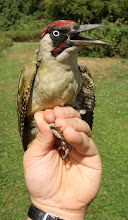
Above: A Lesser Spotted Woodpecker.

I'd always fancied catching one of these at this site since I started ringing there. The River Flit passes through the site and LSW's have been reported up and downstream and within 5 miles of this site. I was only saying to Amanda on Sunday the very same thing! Funny how things work out sometimes!


Above: Lucky git aren't I?!?


Above: A cheeky photograph with the newly installed interpretation board!

A number of Jays were seen. 2 Woodcock were flushed in Upper Alders (wet woodland), lots of fieldfare about, skylarks were singing, 2 buzzards and 2 Little Owls were seen. One that missed the nets (thankfully) was a Pheasant. One that got away was Sparrowhawk - would have been a site first but it extracted itself about two seconds after I realised something large was in the net!

Totals for the day in order of appearance: New (retrap)

Long Tailed Tit 2 (1)
Blue Tit 0 (4)
Robin 0 (1)
Coal Tit 1 (1)
Goldfinch 3 (0)
Great Tit 2 (1)
Wren 1 (0)
Lesser Redpoll 2 (0)
Siskin 1 (0)
Common Redpoll 1 (0)
Lesser Spotted Woodpecker 1 (0)
Chaffinch 2 (0)
Great Spotted Woodpecker 0 (1)

25 birds of 13 species - a good variety.

Sunday, 26 February 2012

Turdus viscivorus

Today I met Amanda at Sandy Smith Nature Reserve (SSNR). The first bird of the day was a Chaffinch. It turns out this Chaffinch was ringed somewhere other than SSNR and by somebody else other than me.

This is the first time I've caught somebody else's bird at SSNR and I'll be very interested to hear where it came from (it did have a British ring on it).

A rare Coal Tit and Greenfinch were good to get. Before Amanda left, she helped me put a net up in a new location decided upon by observations (both on the day and previous).

After Amanda left, I caught a site ringing first - Starling. Presumably coming to the peanuts, this bird was caught in my normal netting area.


Above: Starling

It was late lunchtime by now and I wanted to be back home by 3pm to see the Carling Cup final coverage. So, after ringing the Starling, I took down the usual nets and went to the new net site. It had caught something...


Above: Mistle Thrush - Turdus viscivorus

Another site first and a ringing 'tick' for me (my 4th self caught tick - all of which have been at SSNR). I couldn't have done it without help so thanks go to Amanda.

All in all, I was very pleased with the day's efforts and it was topped off by Liverpool winning the football.

Today's totals:

Chaffinch 4 (0) and 1 control
Dunnock 1 (3)
Great Tit 1 (4)
Coal Tit 1 (0)
Greenfinch 1 (4)
Blue Tit 2 (0)
Goldfinch 4 (1)
Starling 1 (0)
Mistle Thrush 1 (0)

25 birds of 9 species.

Yesterday, I was at Priory Country Park. On the non-bird front, I saw a Stoat! On the bird front, in order of appearance, ringing stoatals were: New (Retrap)

Blue Tit 9 (9)
Long Tailed Tit 0 (4)
Dunnock 1 (4)
Blackbird 1 (0)
Song Thrush 1 (0)
Bullfinch 2 (2)
Great Tit 11 (8)
Wren 0 (1)

53 birds of 8 species.