Sunday, 27 June 2010

Sandy Smith Nature Reserve 26/06/10

Yesterday was very hot and I suffered in the heat, but it was worth it:

10 new Common Whitethroats (including 3 juveniles), 2 new Sedge Warblers and 1 retrap. Plus two new and sucessful net rides.

In all, I have caught 18 new whitethroats in my last 3 visits here. The site is full of them!


Above: One of the juvenile Whitethroats.


Above: The tail of an adult whitethroat.


Above: Net ride 1.


Above: Net ride 2.


Above: A catch (Whitethroat - what else!)

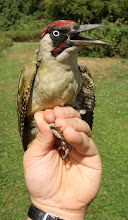
Providing interest during the day were a number of VERY noisy Green Woodpeckers constantly to-ing and fro-ing over the nets (youngsters must be about). I'm quite confident of catching one here with a bit of luck.

A flash of colour seen out of the very corner of my eye proved to be a Kingfisher flying along the river and an alarm call from a kestrel (presumably nesting) alerted me to a Red Kite.

Just after midday, I met up with Liz Millbank (Greensand Trust Ranger) and co. at the end of their guided walk around the site (orchids and flutterbies were seen). They were also fortunate enough to see the Red Kite. Before Liz left (and after she had been sniffing otter spraint!) I pointed out a Kingfisher carrying food (a site tick for the year) and lucky few hung around long enough to see me process a retrap Sedge Warbler.

All the data has now been entered on the computer ready to be sent for checking by my trainer and then sent to BTO. Perhaps one day I will get some info back from the BTO telling me where one (or more) of these birds have been recaught? I'm hoping so!

Sunday, 13 June 2010

Sedge Warblers and Whitethroats

Whilst England were mustering a fairly inept performance in the World Cup, Errol and I went to Sandy Smith Nature Reserve for an evening attempt to catch Grasshopper Warblers and perhaps prove breeding.

No Grasshopper Warblers despite 360ft of nets. Whether I was just lucky in catching one last week, or that we don't know the site well enough yet is something only time and further visits will tell.

We did catch 5 Whitethroats - 2 retraps from last Sunday and 3 new (2 males, 3 females of which two were in egg). Also, 4 new Sedge Warblers (all adults - 3 male, one female) - I caught and released one unringed last sunday because it had scaly legs.


Above: A Sedge Warbler.

With it being a very nice evening and with us not being that busy, we were able to enjoy some of the supporting cast ...


Above: A ringing demonstration was given to this herd.

Errol watched 2 hares boinking. A cuckoo was heard and seen, a Jay flew past and a Great Spotted Woodpecker was going to and fro constantly. At dusk, a Little Owl was to be seen surveying territory from the telegraph wires. And just as we were leaving we saw a hunting Barn Owl.


Above: This photograph of a Barn Owl was taken elsewhere in Bedfordshire back in May whilst I was helping Amanda check Barn Owl boxes.

And in the morning whilst ringing at Priory Country Park, we had a flyover Red Kite.

A pretty good day - despite the footy result.

Sunday, 6 June 2010

Tickity tick, tick ... tick BOOM

In the past I have had to rely on my learned friends (i.e. other ringers), for all my ringing ticks (thanks guys!) - 76 to date in total.

Today brought a tick entirely of my own and I cannot be more pleased (having imagined or more accurately day dreamed about this yesterday).

Without more ado, I present to you a Grasshopper Warbler:


Above: I have high hopes of catching more of these at this site.


Above & Below: V670807 is now a well photographed bird!


Below: Not a flattering angle to photograph a bird ... but it shows some of the plumage details nonetheless.


Below: Spotty throat.


Below: The ringing bible says this is one way to make sure this is actually a Grasshopper Warbler. The measurement of the notch to the tip of the 2nd primary should be between 8 and 11.5mm.


As you can see, this 2nd primary comes in at just over 10mm.

I think I shall be trying to ring more of these ... and sooner rather than later!

Sandy Smith Nature Reserve

I have adopted Sandy Smith Nature Reserve (nr Clophill, Bedfordshire) as my ringing site. The site is owned and managed by the Greensand Trust - it was donated to the trust by Peter Smith and named after his wife.

The site is quite diverse - dry & wet grassland, reed beds, alder dominated wet woodland and it is bordered by broadleaf woodland and paddocks. The River Flit runs through the site. As you might imagine, there is quite a variety of birds in the locality.

Today I had a 60ft net up by 7am and finished at 12.15pm. Very modest numbers were made up for by the catch.


Above & Below: 1 of 5 Whitethroats caught (all new).


The other birds caught: 1 dunnock and 1 great whopper of a ringing tick (see more recent post!).

Saturday, 29 May 2010

Menorca Birds 2010 Edition 7 - Tawny Pipit

Driving along the road, I stopped the car right next to this bird. It didn't fly away. I was in the drivers seat and the bird was on the passenger side of the car. Luckily my Cannon EOS 1000D was at hand on the seat and I was able to take a few snaps.


Above & Below: A Tawny Pipit.

Wednesday, 26 May 2010

Shadow play...

Cap de Favoritx, Menorca was a bit of a barren landscape. Everywhere we visited on else on this island had green vegetation in abundance. Here however, there was no green - just shades.


Above: Thumbs up!


Above: Hello!


Above: A weak joke ...!

Wednesday, 19 May 2010

Menorca Birds 2010 Edition 6 + Drain Pipes ... of course!

We went for a walk from Cala Galdana up Algendar Gorge (having already done part of the gorge from the other end where I got photographs of the Egyptian Vulture). We were aware that this was a great place to go for migrating birds but missed this on our visit last year.

I didn't find anything spectacular, or add anything to my holiday list but I did get some good photographs.


Above: A Sand Martin. I tried to find a crag martin during the holiday - unsuccessfully.


Above: Lots of house martins resting in a Tamarisk tree after an arrival.

The weather wasn't great but as the water droplets came down with increasing regularity, I noticed a significant arrival of House Martins on the way back to the car that weren't there on the first pass. Numbers must have been around the 4 figure mark.

Last year, whilst walking around I noticed a variety of 'interesting' (to me anyway)drainage solutions.


Above & Below: These are both the same house.


Below: This one was not such a good example. It is draining water from a balcony above but is clearly staining the wall. Most buildings in Menorca are white and I reckon they must sell billions of litres of white paint every year!


Below: Somebody with a sense of humour, although technically, I don't think it would be draining water from anywhere!

Saturday, 8 May 2010

Menorca Birds 2010 Edition 5

Still more photographs from Menorca:


Above: Although I got a view of Purple Heron flying, this was the best view I got whilst one was grounded.


Above: An influx of Bee-eaters (50+ at Cala Tirant) occured on 27th April. The light was poor but I did get this photograph.


Above: A stonechat near our appartment at Arenal d'en Castell. There were Stonechat all over the place.


Above: A hoopoe near our appartment at Arenal d'en Castell. I saw several of these across the island but this was the only opportunity I got for a photo.


Above: The morning after the storm, I got close enough to this Turtle Dove to photograph it without the scope and just my Panasonic Lumix FS7 compact camera! I treated me almost as a pigeon in the town centre would!


Above: My dad walked straight past this - a land turtle (of the Testudo hermanni subspecies. Apparently it was brought to the Balearic Islands in very ancient times. Adults can grow to a lenght of 20cm with the males being smaller in general than the females.


Above: And the hare said to the turtle ...

Mediterranean Storm

During the night of 3rd/4th May, I spent an hour unable to sleep in our appartment in Menorca due to a severe storm, the likes of which I've not seen before. The wind was banging the shutters around and the outdoor chairs and tables were getting blown around everywhere! I've no idea what the birds did to stay out of the worst of it!

By the next morning, the wind had calmed down.


Above: A view of the local coastline (taken last year) in normal circumstances (no waves to speak of) - this bit is quite sheltered.


Above: The same place from further back and a slightly wider angle, the morning after the storm.


Above: A wider angle still - further out where it is a bit more exposed.

Friday, 7 May 2010

Menorca Birds 2010 Edition 4

A variety of digiscoped images from Menorca:


Above: An Egyptian Vulture in Algendar Gorge - a site great for migrating birds and a dramatic landscape.


Above: An Audouin's Gull at Punta Prima. I've noticed that I tend to only find these gulls on the south coast of Menorca.


Above: A Kentish Plover (left) and Little Ringed Plover (right). My first ever Kentish plover!


Above: A Blue Rock Thrush near Pont d'en Gil.


Above: A digiscoped image of the moon.


Above: A Common Sandpiper along the coast near Es Grau.