Showing posts with label Blackcap. Show all posts

Thursday, 31 January 2013

Recoveries

I received an interesting recovery this week involving a female Blackcap ringed at Priory Country Park on 14/09/11 (one of 25 that day). It was controlled at Portland Bill, Dorset on 28th April 2012.

Above: A library picture of a female Blackcap

Looking back at the database for Priory, there have been a number of recoveries involving Blackcaps, but most involve birds caught leaving the country in the South East (e.g. Kent, Icklesham). This is the first recovery of a Priory CP ringed Blackcap caught entering the country on migration (the only feasible explanation for the location and timing), and this is in the South West.

There is clearly a migration pattern going on here, perhaps to do with strategy and or wind direction.

In other news, I caught a control Corn Bunting the other week. It will be interesting to see where that has come from - they are a sedentary species. The BTO online recoveries report shows that there have been no previous recoveries in Bedfordshire (either ringed here and found elsewhere - or vice versa). Up to 2011, there have only been 96 recoveries nationally.


Above: The controlled Corn Bunting


Above: A sunset at Priory Country Park.

Now to get on with catching more birds with other peoples rings on and ring plenty so that other people can catch them! That is, if this wind will calm down....

Sunday, 2 December 2012

Another day, more birds!

Ringing today took place at Priory Country Park. I wanted to try for Corn Buntings coming to roost again on the crescent but on inspection, the ringing rack was mostly under water (waders needed) so this plan was abandoned. I did put my nets up in the rough though.

It was a slow start but by the end of the day, I had caught enough birds to make it a successful day.


Above: An adult male Kestrel. Only the second to have been ringed at Priory Country Park in over 20 years. Perhaps the cold and the frost had forced this individual to hunt for food and shelter in or near the Rough (the main ringing area). It was being mobbed by a Magpie or two before it and the Magpie were caught in the net (the Magpie escaped just before I got to it!).


Above: A female Blackcap. 2 males were also ringed. Good records. After my Strasbourg ringed individual yesterday at Sandy Smith Naure Reserve (see here), we're hoping these will get recaptured somewhere on the continent next spring/summer!


Above: One of 6 Lesser Redpolls. I have now caught 25 Redpolls at Priory CP this autumn.

Totals for the day (retraps in brackets):

Kestrel 1 (0)
Wren 2 (2)
Dunnock 0 (1)
Blackbird 5 (0)
Blackcap 3 (0)
Goldcrest 1 (1)
Long Tailed Tit 0 (2)
Blue Tit 1 (2)
Great Tit 1 (1)
Chaffinch 1 (0)
Lesser Redpoll 6 (0)
Bullfinch 3 (0)

The Kestrel was the obvious highlight closely followed by the 6 Lesser Redpolls.

Ringing more Blackcaps, Lesser Redpolls and Blackbirds are a priority at the moment as these have more potential to go somewhere interesting - and be found (though in truth I'll ring anything I can catch at the same time!).

Whilst out ringing I spotted, deep in the brambles, one of my (presumed) stolen bird feeders! 10 minutes of work with the shears and I had retrieved it - in tact. I then put it back up with nyger seed in it. Before I left, I also found half of the peanut feeder so just one and a half left to find! I am now pretty sure they are there to be found, just that they are buried deep somewhere. If I can find them, I'll put them back up

I think that I got caught in a battle between people inappropriately using the park (building dens & stealing materials to do so) and the rangers (trying to stop it). The den builders probably thought the feeders were council property & threw them away to make them difficult to find. This ties in with damage to council property at the same time. Bizarrely given the situation, I enjoyed the exercise it took to cut back the vegetation in order to get the feeders. So it did me some good!

Saturday, 1 December 2012

Are winter Blackcaps from the continent?

Having blogged in previous posts about catching a couple of winter Blackcaps recently. Our overwintering population of Blackcaps are thought to be continental in origin rather than being part of the summer population overstaying.

Perhaps the control juvenile female Blackcap I caught today at Sandy Smith Nature Reserve has something to add to this story. I can't show you as I didn't have my camera, but it had a Strasbourg ring on!

So it was hatched this year (on pointy tail shape for you ringers) and has moved roughly in a North Westerly direction since it was ringed, to find itself in the heart of Bedfordshire, England. And that's all I can tell you about my first self caught foreign ringed bird.

Totals today amounted to 55 birds (22 new and 33 retrap) of 13 species (retraps in brackets)

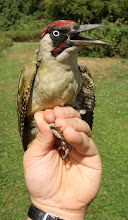
Great Spotted Woodpecker 2 (0)
Wren 1 (0)
Dunnock 1 (1)
Robin 1 (1)
Blackbird 4 (0)
Song Thrush 2 (0)
Blackcap 0 (1) A control from the 'Strasbourg' area!
Long Tailed Tit 0 (1)
Blue Tit 3 (18)
Great Tit 2 (10)
Chaffinch 0 (1)
Goldfinch 2 (0)
Lesser Redpoll 4 (0)

In my last post, I told you that I needed 186 handlings to beat my 2011 total for Sandy Smith Nature Reserve. After today, I need 131. If I'm lucky I can do that in 3 sessions, and if that luck holds, I can fit those 3 sessions in before the end fo the year. I'm still hoping!

Saturday, 24 November 2012

Large and Little

As I was driving into Sandy Smith Nature Reserve (SSNR) this morning a Buzzard (Large) was sat on a post nearby (the other week it was on a post next to the road) but a surprise came a little further on in the form of a bird of prey (Little) sat on a fence. It let me stop the car, roll down my window and even reverse my car to get a better camera angle without flying away. It was all of about 2/3 metres away.


Above: Merlin at Sandy Smith Nature Reserve today (24/11/12).

Given that this bird did't fly away as soon as the car came near, I had to check that it was ok. On exiting the car it did fly away so yes, it was ok and it was definitely not plastic! Not wanting to disturb it any more and wanting to get on with my ringing session before the rain arrived, I carried on.

Todays ringing session produced 40 birds of which 13 were new and 27 retraps as follows:

Great Spotted Woodpecker 0 (1) - a new longevity record for the site at 1 year, 348 days.
Wren 1 (1)
Robin 0 (1)
Goldcrest 1 (0)
Long Tailed Tit 0 (2) - one being a new longevity record for the site at 2 years, 80 days.
Coal Tit 0 (2)
Blue Tit 4 (11)
Great Tit 0 (9)
Treecreeper 2 (0)
Chaffinch 2 (0)
Goldfinch 1 (0)
Lesser Redpoll 2 (0)

Above: One of 2 Treecreepers ringed at SSNR today (the 2nd & 3rd ringed at this site).


That is now 5 new Goldcrests for SSNR this year (none previously) and 24 Lesser Redpolls (including this Autumn (35 this year).
A ringing session at SSNR on 11th November produced 37 new and 27 retraps:


Wren 6 (0)
Dunnock 0 (2)
Robin 0 (1)
Blackcap 1 (0) - the first winter record for this species at SSNR.
Goldcrest 2 (0)
Long Tailed Tit 9 (7)
Blue Tit 8 (7)
Great Tit 4 (9)
Chaffinch 4 (1)
Lesser Redpoll 3 (0)

The notable bird here being a winter record of Blackcap. Again, more Goldcrests and more Lesser Redpolls. I need 186 more captures to beat last years total number of handlings. I may get 2 or 3 more sessions but I am unlikely to make it - I'll try though!
On the weekend between the 2 catches above, I went to Gloucester to see family. On the Sunday (18th Nov) I managed a ringing session at my Dad's house in the Cotswolds:

Dunnock 3 (2)

Blackbird 1 (1)
Blackcap 1 (0) - A new species for this site
Goldcrest 4 (0) - A new species for this site
Long Tailed Tit 7 (0)
Coal Tit 1 (0)
Blue Tit 13 (5)
Great Tit 1 (0)
House Sparrow 4 (0)

Given that I don't ring this site very often at all (my last session there was last Christmas), most retraps are likely to produce a longevity record for the site.
The retrap male Blackbird was first ringed 2 years, 285 days before its later recapture. I assume this is one of a ringed pair my dad regularly reports as coming to feed on the scraps he is always putting out for the birds.
One of the retrap Blue Tits was first ringed 2 years and 327 days previously (now the oldest record for the site).

Above: Male Blackcap - a good winter record at my Dad's house in the Cotswolds. I have seen Blackcap maybe once or twice before at his house in 20 years.

As ususal, I hope to be able to share more bird ringing news soon! Wish me luck... and dry weather!

Wednesday, 4 April 2012

Spring Migration

Spring migration for birds in 2012 is definitely underway. The first Chiff Chaff's started appearing 2-3 weeks ago and Blackcaps are moving through. In the last couple of days, Willow Warblers have started arriving (though as yet I haven't ringed this species this year). Large numbers of more species will arrive in the next month and I hope to catch up with Grasshopper Warblers and Whitethroat (at SSNR) before going on holiday towards the end of April.


Above: A Male Blackcap


Above: A female Blackcap - out of 10 ringed at Priory Country Park in the last 2 weekends, only 1 (this one) has been female. Several were carrying fat suggesting they haven't finished their migration yet.

A few Chiff Chaff's have also been trapped, including one ringed at Priory CP last year.

Reed Buntings are not one of the species you would immediately associate with spring, but in March Reed Buntings make their appearance at feeding stations. I first noticed this last year at Sandy Smith Nature Reserve (SSNR) as in March and April this species was caught in the feeding station net rides whilst for the rest of the year they were absent from this area. I have read reports of Reed Buntings found at Garden feeders during this time also. The same occured this year at SSNR and at Priory Country Park (PCP).


Above: This pair of Reed Buntings were ringed at SSNR.

Tonight I recieved confirmation that a Blue Tit (ring no. Y230511) caught at Priory Country Park on 7th Sept 2011 was originally ringed at Willington, Bedfordshire on 3rd July 2011, 66 days earlier, 3km away (west). Originally caught by MT, I may even have attended this ringing session! This isn't a significant movement but it was the first of 3 birds I have now caught with somebody else's ring on. Here's hoping for more!

There's not been a great deal else to report except for a Ringing Demo held at Priory Country Park on the last Sunday of March where we were lucky enough to demo a Treecreeper, Great Spotted Woodpecker and the first Blackcap of the year on a foggy morning (it didn't start that way!).

Saturday, 3 September 2011

Priory Country Park - Of late

The Constant Effort season is over at Priory Country Park. All 12 visits were completed (including the odd extra visit). I haven't posted CES totals for a while and on this occasion, for my ease, I'm going to lump visits 8-12 all into one (including non-CES birds/sessions).

238 new birds, 57 retraps (in brackets) of 23 species:

Wren 8 (1)
Dunnock 6 (6)
Robin 6 (7)
Blackbird 10 (8)
Song Thrush 8 (1)
Sedge Warbler 1 (0)
Reed Warbler 24 (1)
Whitethroat 25 (6)
Lesser Whitethroat 2 (0)
Garden Warbler 19 (2)
Blackcap 91 (8)
Chiff Chaff 2 (3)
Willow Warbler 2 (1)
Blue Tit 8 (5)
Great Tit 6 (3)
Long Tailed Tit 0 (1)
Chaffinch 3 (0)
Goldfinch 10 (0)
Greenfinch 1 (0)
Bullfinch 4 (3)
Treecreeper 0 (1)
Sparrowhawk 1 (0)
Wood Pigeon 1 (0)

We'll start with the standout total for Blackcap. This site has always been good for Blackcaps - more Blackcaps have been ringed than just about all other species in the park. The total above includes birds caught outside the CES. On Saturday 27th August I caught 26 Blackcaps (the majority new and the majority male). These birds must have moved on and another lot moved in as by the following Wednesday (31st August) I caught 30 Blackcaps (only one retrap from the weekend and only because it's from a late brood & not ready to go yet).

I call on all ringers north of Bedfordshire to get a move on and ring some Blackcaps! Out of all the Blackcaps I've ringed here in the last week or two, none have been ringed other than on site. You can increase my chances of catching one of your birds!


Above: Female Blackcap


Above: Male Blackcap


Above: This bag contains a big living ball of feathers (see below)!


Above: A Wood Pigeon (the big ball of feathers).


Above: A Lesser Whitethroat. This bird represents one of two ringed on 27th August. This species used to be more regular in the park but there have been very few records this year. I assume therefore that these two birds (juveniles) were migrating through the park (we would likely have caught the adults & juveniles earlier if they had bred).


Above: Normally seen in the skys above & normally too good at airobatics to be caught. This juvenile Sparrowhawk is obviously still learning then!

Saturday, 4 June 2011

Juvenile behaviour!

No, not my behavior, or my brothers (for once)! It's the time of year when we start seeing good numbers of juveniles from the early breeders.

SSNR 30/05/11: 21 birds of 8 species (retraps in brackets)

Great Tit 9 (0) - including 6 juveniles
Whitethroat 4 (1) - the retrap being first ringed as an adult June 2010.
Grasshopper Warbler 1 (0) - the 5th this year for this site and the first female
Blackcap 1 (0) - only the third of this species for the site
Dunnock 0 (2)
Chiff Chaff 1 (0)
Sedge Warbler 1 (0)
Great Spotted Woodpecker 0 (1) - A regularly caught male.

SSNR yesterday 04/06/11: 55 birds of 11 species (retraps in brackets)

Blue Tit 4 (3) - all the new birds were juveniles
Great Tit 4 (0) - including 3 juveniles
Whitethroat 6 (3) - one of the retraps being from June 2010
Chaffinch 9 (1) - including 6 juveniles
Goldfinch 7 (2) - including 2 juveniles
Garden Warbler 3 (0) - 2 males and a female (NEW FOR SITE)
Grasshopper Warbler 0 (2) - a pair
Willow Warbler 1 (0) - the first adult caught on site
Blackcap 8 (0) - mostly adult males except 1 adult female and one juvenile
Dunnock 0 (1) - first ringed on 3rd March 2011
Sedge Warbler 0 (1) - a retrap from May 2011

This is not typical of visits to SSNR and it came as a very welcome surprise. I suspect there are a few reasons for this:

1. weather - overcast first thing (lifting but not completely later on) and wind from the east ('light' to start with increasing to 'far too' by the end of the session). Normal = windy and from the west. Perhaps this was partially responsible for catching a lot of blackcaps (rarely ringed here) and the Garden Warblers (where did they come from?!?).


Above: Garden Warbler

2. I've not ringed at this time of year here with a feeding station. Without this, the catch would consist mainly of Warblers.

3. Juveniles - it's that time of year. Blackbirds, Robins, Dunnocks, Whitethroats, Blue Tits, Great Tits, Song Thrushes, Chaffinches, Starlings, Blackcaps - I have seen fledged young of all these species around Bedfordshire. Some examples coming up (all juveniles):


Above: Great Tit


Above: Blue Tit (taken at Priory Country Park).


Above: Robin (taken at Priory Country Park - no juvenile Robins have been caught so far at SSNR).


Above: Blackcap


Above: Goldfinch


Above: Chaffinch

Monday, 2 May 2011

Constant Effort visit 1 - Priory Country Park

Sunday 1st May was the start of the CES season - it was sunny all morning. Chilly first thing with the wind picking up intensity throughout the morning probably resulting in a reduced catch in the second half.

18 birds of 12 species: New (retrap)

Bullfinch 3 (0)
Cetti's Warbler 0 (1)
Dunnock 2 (0)
Wren 0 (1)
Whitethroat 1 (0)
Reed Warbler 1 (0)
Blackbird 0 (2)
Garden Warbler 1 (1)
Goldfinch 1 (0)
Blue Tit 0 (1)
Chiff Chaff 2 (0)
Blackcap 1 (0)

Interesting info on some of these birds:

1 female Blackbird was born in 2008.
1 male Blackbird was born 2007 (first caught in 2008)
1 returning male Garden Warbler was ringed as an adult in 2010
The female Bullfinch's have well developed brood patch's
A male Blackcap with a false brood patch.


Above: A male Blackcap


Above: A Chiff Chaff


Above: Cetti's Warbler

A ringing demonstration was held for the 'Dawn Chorus' Walkers who were treated to close up views of the Cetti's Warbler (first ringed in April in the park).