Showing posts with label Kingfisher. Show all posts

Sunday, 17 August 2014

A cracking day...

Yesterday, Saturday 16th August, I made a visit to Sandy Smith Nature Reserve - same as I do most weekends. Starting at the crack of dawn, I set up my nets and I was well rewarded for my efforts.

The weather conditions and time of year, all play their part in the presence (or absence) and abundance of birds and the species I might catch. This year Blue Tit juveniles have been rather thin on the ground, as have Common Whitethroats despite what appears to have been a good year weather wise for breeding.

Yesterday, the ringing results showed 2 things - no Common Whitethroats (I should still be catching them) and a marked increase in the no. of Blue Tits ringed. This increase is probably as a result of birds from 'further afield' arriving on site.

In the end, I caught 111 birds of 15 species. This being the joint highest ringing total for a single day at this site.
Of course, I took some photographs...

Above: A juvenile Jay (3rd youngster ringed this year) 

Having caught 1 Jay (2013) previous to this year, it has been a pleasant surprise to catch 5 so far this year (3 adults, 2 juvs). My main ringing area is being left to mature into (mainly Alder) woodland, with some planting to speed up the process - so perhaps this is a sign that Jays are finding the habitat more to their liking. Or they may have just found a way to take advantage of my feeding station!

Above: Juvenile Kingisher (1 of 2 ringed)

The Kingfishers have been bombing around up and down the river on a regular basis throughout this year (the mild winter benefitting this species as survival is greater). Kingfisher breeding is also prone to being devastated by floods but that trouble, thankfully, has been avoided this year. Not a species I catch regularly, but two juveniles were ringed today (the brown tops to their legs giving their age away - adults have crayon red legs).

But as the breeding season is coming to an end, I am starting to see evidence of migration in the ringing results. Migrants need places to stop and refuel before continuing their journey. They might choose a site to stop at for the habitat and food they find there or simply because they are forced down by bad weather conditions. Either way, it's that time of year. The star bird of the day - and definitely a migrant was...


...this Lesser Whitethroat. It is a cracking bird in the hand. It stole star bird status away from the 2 Kingfishers, the Jay, 2 Magpies, Nuthatch, Willow Warbler and Goldcrest because it is the first of this species to be ringed at Sandy Smith Nature Reserve. The Magpies only made it onto the list because they were the 3rd and 4th to be ringed here - definitely coming to the feeders. On the last session, it was Ringer 1, Magpie 5. This time it was Ringer 2, Magpie 0 but I lost 3-5 on an aggregate score! Joking aside, that makes 3 this year - the only previous one came in 2012.

Another migrant was a juvenile Willow Warbler. The only other one I've caught this year was an adult undergoing moult (and presumably on migration too) back in June.

A juvenile Goldcrest, was the fourth of the year! This is a fairly short lived species because of their size and vulnerability in the winter to cold weather - so good winter survival and a good breeding season for this species too.

It is worth mentioning Nuthatches too - they are heard near my ringing area regularly at the moment (probably 2 yesterday) and with only 1 previous to this year in 2012 and 4 so far this year they would appear to be increasing in numbers. Hopefully some retrap data will provide some more knowledge about this species use of the reserve.

Kingfisher 2 (0)
Wren 2 (1)
Dunnock 3 (4)
Robin 4 (0)
Lesser Whitethroat 1 (0)
Blackcap 8 (0)
Chiffchaff 3 (0)
Willow Warbler 1 (0)
Goldcrest 1 (0)
Blue Tit 18 (14)
Great Tit 9 (32)
Nuthatch 0 (1) - this retrap increases the site longevity for this species from 8 to 13 days!
Jay 1 (0)
Magpie 2 (0)
Chaffinch 0 (4)

I was pooped by the time I got home, but it was a cracking adventure Gromit!

Wednesday, 3 July 2013

Contrasting totals

On Friday of last week, I took the day off and, as the weather conditions were better than of late, I put up some nets at Sandy Smith Nature Reserve (SSNR). A decision that proved to be productive with 68 birds captured. 60 of these were new and 8 were retraps of 13 species. 17 were adults and 51 were juveniles.

A while back now, I saw a Jay on my feeders and a couple of others around my netting area so it was only a matter of time:


Above: The first Jay ringed at SSNR (this being the 46th species I've ringed here).


Above: An adult Kingfisher.

This was the first Kingfisher ringed here for nearly 2 years. Recent hard winters and the flooding of nest sites have meant this species has been in decline recently. Sightings at SSNR used to be regular along the river up to 2 years ago but have been rare of late so nice to ring one.


Above: A juvenile Long Tailed Tit - one of many ringed on Friday. At 44 new for year Long Tailed Tits in 2013, this is the highest year total for the site.

Totals:

Kingfisher 1 (0)
Great Spotted Woodpecker 0 (2)
Wren 0 (1)
Dunnock 2 (1) - including a juvenile
Robin 0 (1)
Whitethroat 0 (1)
Blackcap 6 (0) - mostly juveniles
Long Tailed Tit 17 (1) - mostly juveniles
Blue Tit 3 (1) - mostly juveniles but surprisingly few of them
Great Tit 19 (0) - mostly juveniles
Jay 1 (0)
Chaffinch 7 (0) - including several juveniles
Goldfinch 4 (0) - including 1 juvenile

In contrast, a visit to Priory Country Park on Saturday morning, CES visit 6 was carried out and produced a meagre total of 12 birds. Of note were juveniles of the following species: Great Tits, Blackcaps and a single juv Whitethroat (suprisingly absent from SSNR the day before apart from one retrap adult). What a difference a day makes - even if it is a different site.


Above: A Juvenile Whitethroat 

CES totals have been low so far this year. I've started compiling totals and comparing them to previous years, but there's still a lot of work to do. We know nesting is later this year because of the cold spring weather (and therefore there has been less food), but juveniles are starting to appear and only time will tell how good a breeding year this will be. The last 6 visits will provide crucial information!

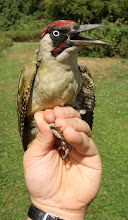
Elsewhere, I saved a juvenile Green Woodpecker from being squished on the road. It may have been injured (not flying) so it was put in a safer place and left unringed.

The weather for this weekend looks good (a lot less wind) so I hope to have more news.

Sunday, 13 February 2011

January ringing highlights

The weather has been variable recently, to say the least. December was freezing and with all the snow, this stopped ringing activities. By the new year the snow had gone and a session Sandy Smith Nature Reserve (SSNR) on 8th Jan produced just 3 birds; a Coal Tit, Blue Tit and this:


Above: A Kingfisher that had survived the December freeze!

Severe wind (no, not anything to do with my digestive tract) has been the main problem in January. MT and I made an attempt for Waxwing (2 attempts) and Tree Sparrows (1 attempt) but with waxwings being difficult to catch and the wind, we drew a blank. Birds 3, Ringers 0. Being positive, we did see a lot of waxwings and got to know Shefford a bit better!

I also went looking for a Bittern at Priory Country Park (it's been seen there regularly since just before Christmas) but I drew a blank.

Instead of chasing Bedfordshire rarities, I wanted to chase Siskins at SSNR.

SSNR on 22nd Jan: 4 Blue Tits, 5 Great Tits and 1 Coal Tit. No Siskins (200 + still around).

SSNR on 30th Jan: 4 Blue Tits, 2 Great Tits, 1 Robin, 1 Chaffinch, 1 Coal Tit and 2 new species ringed for the site, 2 Goldfinch and 1 Blackbird. No Siskins (still around though between 100-150).


Above: The first Goldfinch ringed at SSNR.


Above: The first Blackbird ringed at SSNR.


Above: A female Chaffinch.

A combination of the time of year, weather (wind, rain, warmth), increased natural food sources and unknown factors, means reduced catches but with a Kingfisher and 2 new species for SSNR, I feel the effort was worth it. There's still time for Siskins in the next month or two... I hope!

Saturday, 24 July 2010

Sandy Smith NR Ringing Demo 21/07/10

I've helped on ringing demo's before but I organised and delivered my first demo on Wednesday. We didn't catch many birds (4) but one made up for at least 10 that we didn't catch!

A big thanks to all who attended the ringing demo put on by Errol and myself at Sandy Smith Nature Reserve. A special thanks to The Greensand Trust, Liz Millbank for helping organise and Steve Squire for mowing the path & the photographs. I hope you all enjoyed it - I certainly did.

Total for the evening:

Whitethroat 2 (1 adult and one juvenile) - a site speciality. The juvenile was one I had caught earlier (just out of the nest) & it's primary feathers had grown a further 9mm in 10 days!

Kingfisher 1 (juvenile) - this more than made up for the lack of other birds!

Song Thrush (juvenile) - this was as we were taking nets down in the fading light. Sorry if you missed it!


Above: An adult kingfisher has crayon red legs, this juvenile has dark legs on top.


Above: The flash of blue that is normally seen.


Above: Here I am taking a wing measurement.

I have ringed kingfishers before (3 I think and handled several more) but this is the first kingfisher I have ringed on my own rings.