Showing posts with label Lesser Redpoll. Show all posts
Showing posts with label Lesser Redpoll. Show all posts
Thursday, 22 August 2013
More recoveries and a surprise in the nets!
News of other recoveries have now reached me and are as follows:
LESSER REDPOLL, ringed Sandy Smith Nature Reserve (Bedfordshire) 24/11/12, controlled Catterick Garrison, North Yorkshire 05/05/13. 275 km, 162 days, NNW direction.
SISKIN, ringed Sandy Smith Nature Reserve 08/12/12, controlled Callander, Stirling 530 km, 154 days, NNW direction.
REED BUNTING, ringed Sandy Smith Nature Reserve 26/05/12, field observation Southill, (Bedfordshire) 12/04/13. 6 km, 321 days, NE direction.
A ringing session on Tuesday of this week in my normal ringing area at Sandy Smith Nature Reserve produced a surprise Spotted Flycatcher! When my photograph downloading capability has been restored, I will share a photograph with you. It was a lovely day, starting with a spectacular sunrise (also photographed), a flyover Red Kite and included ringing a number of willow warblers (always nice) and Chiffchaffs as welll as a Coal Tit and several Goldfinches. A total of 78 birds.
A days ringing at Priory Country Park on Monday produced just 23 birds on the Constant Effort Survey but did include the first Lesser Whitethroat of the year and a juvenile Woodpigeon! Also of note (but a sad occasion), I found a dead mole near the ringing area. I took a few photographs. I didn't realise they had such big teeth!
CES totals have been in the 20's for the latter half of the season (apart from one exceptional total of 51) and this year is going to go down as one of the worst in 20 + years. Just one more visit is needed to complete the full collection of 12 visits. More information about CES visit totals can be found here (or just click on the Constant Effort Survey link at the top of the page).

Tuesday, 25 June 2013
Latest news & recoveries
The latest news is, and this comes as no surprise to you all, IT HAS BEEN VERY VERY WINDY. The jet stream being in the wrong place for the time of year (i.e. more or less over us rather than much further north) is causing the colder and windier weather to affect us, to the extent that I didn't manage any ringing last weekend.
Whilst no ringing does not make a happy me, the following information does!
Corn Bunting (NW59646) ringed as a juvenile at Steeple Morden, Cambridgeshire was recaptured by me at Priory Country Park on 13/01/13, 557 days later. A movement of 23 km in a WNW direction. This, to the best of my knowledge, is the first recovery of this species for Bedfordshire (there are less than 100 nationally up to 2012 according to BTO online recoveries data). A nice result.
Long Tailed Tit (DPN712) ringed at Paxton Pits Nature Reserve, Cambridgeshire, was recaptured by me at Sandy Smith Nature Reserve, Bedfordshire on 29/03/13, 556 days later. A movement of 26km in a SSW direction.
Lesser Redpoll (Y486464) ringed at Priory Country Park, Bedfordshire, was recaptured at Bourne Wood, Lincolnshire on 13/04/13, 167 days later. A movement of 71 km in a Northerly direction. This bird was ringed on the same day as a Lesser Redpoll was controlled that had been ringed at Bestwood, South Nottinghamshire. So we now have evidence of an Autumn movement south and a northerly spring movement.
In other news, we've ringed several junvenile Robins, 2 juvenile Blackbirds, a juvenile Dunnock, Chaffinch and Great Spotted Woodpecker. Despite it being a late breeding season (due to the weather), there must be more juveniles out there but without the right weather conditions for mist netting, this ringer won't be catching any of them!
Whilst no ringing does not make a happy me, the following information does!
Corn Bunting (NW59646) ringed as a juvenile at Steeple Morden, Cambridgeshire was recaptured by me at Priory Country Park on 13/01/13, 557 days later. A movement of 23 km in a WNW direction. This, to the best of my knowledge, is the first recovery of this species for Bedfordshire (there are less than 100 nationally up to 2012 according to BTO online recoveries data). A nice result.
Long Tailed Tit (DPN712) ringed at Paxton Pits Nature Reserve, Cambridgeshire, was recaptured by me at Sandy Smith Nature Reserve, Bedfordshire on 29/03/13, 556 days later. A movement of 26km in a SSW direction.
Lesser Redpoll (Y486464) ringed at Priory Country Park, Bedfordshire, was recaptured at Bourne Wood, Lincolnshire on 13/04/13, 167 days later. A movement of 71 km in a Northerly direction. This bird was ringed on the same day as a Lesser Redpoll was controlled that had been ringed at Bestwood, South Nottinghamshire. So we now have evidence of an Autumn movement south and a northerly spring movement.
In other news, we've ringed several junvenile Robins, 2 juvenile Blackbirds, a juvenile Dunnock, Chaffinch and Great Spotted Woodpecker. Despite it being a late breeding season (due to the weather), there must be more juveniles out there but without the right weather conditions for mist netting, this ringer won't be catching any of them!
Saturday, 16 March 2013
Lesser Redpoll recovery details
Back on 28th October last year, I caught a Lesser Redpoll at Priory Country Park which already had a ring on it (not one of mine). The guided bird walk on that day, led by Dave Barnes, were lucky enough to see this bird during a ringing demo and I can now tell you where it came from.
It was originally ringed on 13th October 2012 near Bestwood, Nottinghamshire. It moved a distance of 113km in a South, South East direction, within 15 days. This was evidently part of an autumn migration of birds moving south.
It was originally ringed on 13th October 2012 near Bestwood, Nottinghamshire. It moved a distance of 113km in a South, South East direction, within 15 days. This was evidently part of an autumn migration of birds moving south.
Sunday, 10 February 2013
A new venture
After scoping out a new site (a field with a cover crop near Sandy Smith Nature Reserve) and gaining permission to ring there (thanks Chris), I had to wait a while before the weather decided to produce ringing conditions.
Whilst snow was still on the ground, I had seen at least 300 birds including species such as Reed Buntings, Linnets, Lesser Redpolls, Yellowhammers, Skylarks, Green Woodpeckers, Goldfinch, Blackbirds and Chaffinches in the cover crop. I was sure at least some of the species were catchable and could include birds ringed at SSNR.
The weather finally relented yesterday and despite the weather being a lot milder and fewer birds being about, I did well.
Totals: 70 birds of 11 species comprising of 66 new and 4 retraps (retraps in brackets below):
Great Spotted Woodpecker 1 (0)
Dunnock 6 (0)
Robin 1 (0)
Blackbird 1 (0)
Blue Tit 6 (1) - retrap ringed at SSNR 15/07/12, 209 days ago
Great Tit 1 (0)
Chaffinch 4 (1) - retrap ringed at SSNR 24/11/12, 77 days ago
Goldfinch 1 (0)
Lesser Redpoll 1 (0)
Reed Bunting 41 (2) - both retraps ringed at SSNR 11/03/12, 335 days ago
Yellowhammer 3 (0)
A few record photographs:

Above: A female Reed Bunting
I hadn't expected so many Reed Buntings (I didn't use binoculars or count numbers of each species when I looked at the site) but I'm not complaining... any large catch of Reed Buntings is a red letter day around these parts!

Above: A male Chaffinch
I had expected more Chaffinch to be about, perhaps one of the species that had dispersed since the cold snap (there were fewer Goldfinch too). I did expect to catch a retrap Chaffinch from SSNR where I have ringed 83 in the last few years and I did, albeit a recent one. If I get my timing right, I'm sure there'll be more Chaffinch to ring and retrap.

Above: A male Reed Bunting
From 10 birds ringed at SSNR in the few years, it was nice to retrap 2 of them - both ringed at the same time on the same day. With no retrap records for either site for this species prior to yesterday, the second of the 2 is now the longevity record for both sites by virtue it was recaught a couple of hours later than the first.

Above: A Blue Tit
Catching Blue Tits I'd ringed at SSNR was inevitable really. They must pass between my feeders at SSNR and the residents feeders at Beadlow - they're only a kilometre apart. The retrapped bird was only retrapped for the first time, perhaps showing it prefers the feeders at Beadlow!

Above: A Great Tit
The nets weren't in the ideal position for catching passing Blue & Great Tits but that obviously didn't matter.
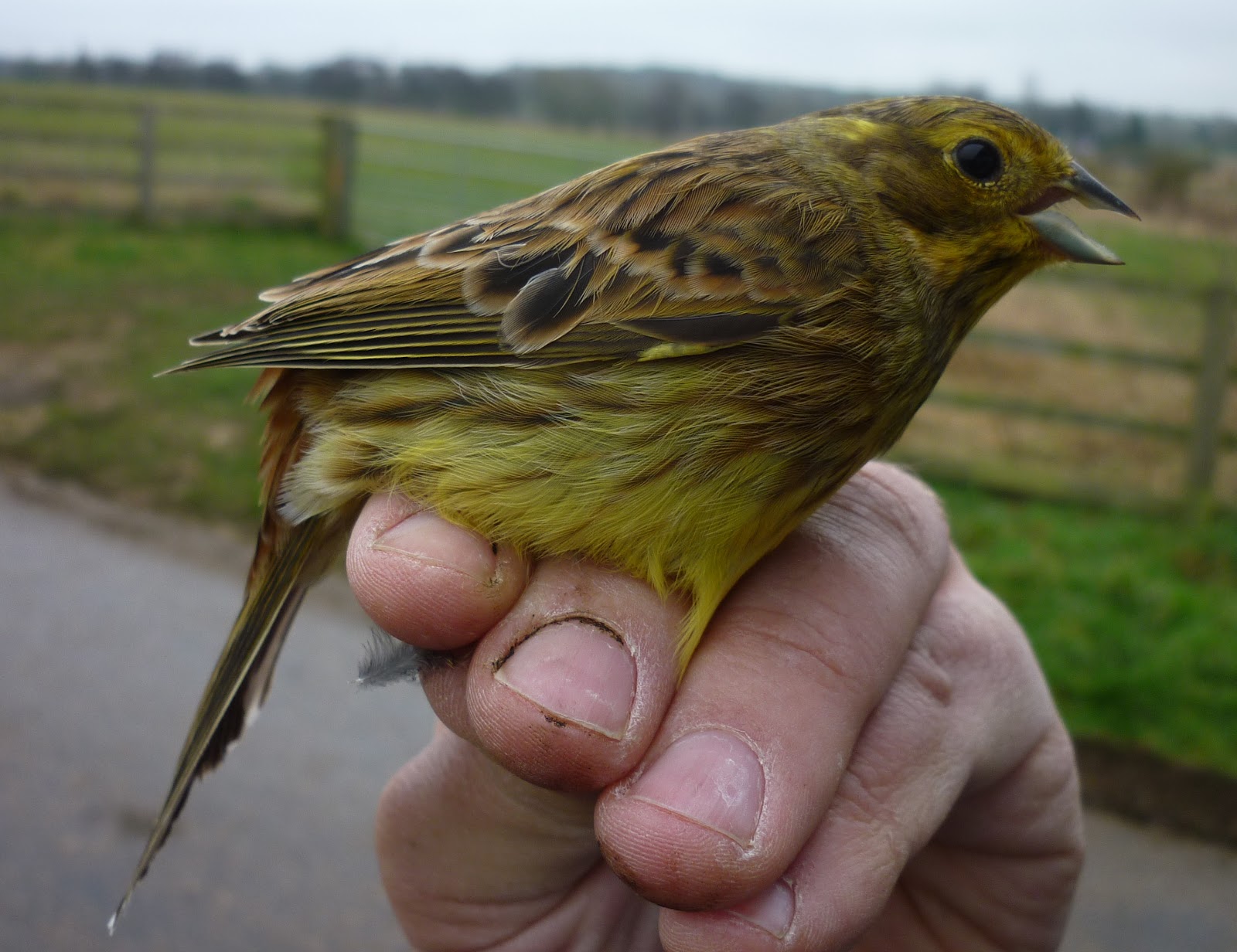
Above: A female Yellowhammer
I have ringed Yellowhammer before (East Yorkshire & Cambridgeshire) but have never caught my own. Yellowhammers have been declining rapidly since the 1980's and may well continue to do so. You can read more about the decline of Yellowhammers on the BTO website here.

Above: A male Lesser Redpoll
I had hoped for a few more of these, but given the milder conditions and location of my nets, this wasn't altogether a surprise.

Above: A Goldfinch
The Goldfinch I had seen before on this site must have dispersed as a lot fewer were seen this time.

Above: A Robin
I'd only seen one Robin here and I saw it collecting nesting material and taking it back to an ivy clad tree. Perhaps this was the one I saw?
Today, the weather has worsened (yet again) so it's chores, chores, chores.... and preparing the equipment for the next ringing session. I have a few pleasant diversions such as remembering yesterdays session, playing the X Box and the England rugby match is on later (though whether this is a pleasant diversion depends on the result!).
Friday, 18 January 2013
My bird ringing in 2012 - Priory CP Review
Well, the weather made it a tough year - and not just for me - for the birds too. Massive amounts of rain over the spring and summer meant breeding was not very successful for most species, but those that could find enough food (Blackbird being one of them) did well. A few planned ringing sessions got cancelled too but I found enough gaps inbetween the wet and windy spells to put more effort in than last year.
The Constant Effort Scheme was operated again (it has been going for 20 years now). Unlike many other people who take part in this scheme across the country, I was among the few who completed all 12 timed visits (plus a couple of extra).
Some effort was put in trying to catch House Martins and Swallows next to the main lake. However, several attempts proved a complete failure. Not a single bird of any species were caught! Unusually low numbers of hirundines (swallows & martins) were passing through on return migration after a poor breeding year and this, along with perhaps choosing a poor site for catching these species, left me scratching my head. There's always next year!
It was my intention to ring at a feeding station during the autumn/winter. New, squirrel proof feeders were required and duly bought. They had been up about a month before they disappeared. It was quite a while before I found 1 and a half of them deep in the brambles. The other 1 1/2 are out there somewhere I'm sure. However, given their disappearance and the cost of replacing them, the feeding station idea was abandoned for this winter.
Total birds handled at Priory CP in 2012 were as follows:
Total New: 640 Total Retrap: 346 Overall total: 986 New for year: 767 No. of species: 33
A species list (along with no.'s of each caught in 2012 can be found on the Priory Country Park page of this blog or by clicking here).
Of special note are the following:
1. A Corn Bunting was ringed (the first at Priory since 3 were caught and ringed in 1991). This was a new species for me and more effort will go into catching this species in the future. Corn Buntings are on the decline and their conservation status in the UK is RED because of a historical decline in numbers and more recently, a breeding population decline. They are hard to catch and I doubt that many have been ringed in Bedfordshire - there has definitely been no recoveries of this species in Bedfordshire as the BTO online ringing reports confirm. However, there will be more about this species in a later post...

2. Only the second Kestrel to be ringed at Priory was caught in 2012. Unusually, the bird was frequenting the area around the ringing site and perching low down in the trees. The first was ringed in 2003.
3. Only the second Jay to be ringed at Priory was caught this year (the first was ringed in 2000). This year was unusual in that there was an 'erruption' or mass migration of Jays across the country. Record numbers were being observed migrating. There is conjecture as to whether these birds are foreign or british ones, however I have read that there is no evidence to support that these were foreign birds.
4. Lesser Redpolls - previously a total of only 9 had been ringed at Prioy before 2012. However, effort has gone into ringing this species and a total of 28 individuals were ringed in 2012. In addition, the first Lesser Redpoll of the year here was a control (i.e. somebody else's ring!). I am eagerly awaiting the original ringing details of this bird.

Recoveries:
Blackcap: Ringed in Sept 2011 at Priory, this bird was captured at Grafham Water in May 2012 - presumably it was breeding there.
A Mallard ringed on the Embankment in 2003 was found dead at Priory in March 2012.
Awaiting details of the control Lesser Redpoll.
Details of the controlled Goldcrest from December 2011 came through this year, it was ringed at Flamborough Head (East Yorkshire) in September that year.
Now for the down side - most species didn't manage a good breeding season. I haven't delved too deeply yet into the data as I have a lot of background work to do before I can say anything with confidence, however the totals were down on 2011 for most species. In the wet weather, most species would find their food sources washed off the leaves (e.g.. caterpillars that the Tits feed on) however a few might find more food (e.g. more worms for the Blackbirds).The national preliminary CES results can be found here.
For the first time in 22 years, no Willow Warblers were caught at Priory.
Ringing in Priory Country Park has started for 2013. News will be posted in due course. Here's to a good year (he writes as it snows!).
The Constant Effort Scheme was operated again (it has been going for 20 years now). Unlike many other people who take part in this scheme across the country, I was among the few who completed all 12 timed visits (plus a couple of extra).
Some effort was put in trying to catch House Martins and Swallows next to the main lake. However, several attempts proved a complete failure. Not a single bird of any species were caught! Unusually low numbers of hirundines (swallows & martins) were passing through on return migration after a poor breeding year and this, along with perhaps choosing a poor site for catching these species, left me scratching my head. There's always next year!
It was my intention to ring at a feeding station during the autumn/winter. New, squirrel proof feeders were required and duly bought. They had been up about a month before they disappeared. It was quite a while before I found 1 and a half of them deep in the brambles. The other 1 1/2 are out there somewhere I'm sure. However, given their disappearance and the cost of replacing them, the feeding station idea was abandoned for this winter.
Total birds handled at Priory CP in 2012 were as follows:
Total New: 640 Total Retrap: 346 Overall total: 986 New for year: 767 No. of species: 33
A species list (along with no.'s of each caught in 2012 can be found on the Priory Country Park page of this blog or by clicking here).
Of special note are the following:
1. A Corn Bunting was ringed (the first at Priory since 3 were caught and ringed in 1991). This was a new species for me and more effort will go into catching this species in the future. Corn Buntings are on the decline and their conservation status in the UK is RED because of a historical decline in numbers and more recently, a breeding population decline. They are hard to catch and I doubt that many have been ringed in Bedfordshire - there has definitely been no recoveries of this species in Bedfordshire as the BTO online ringing reports confirm. However, there will be more about this species in a later post...

Above: A Corn Bunting
2. Only the second Kestrel to be ringed at Priory was caught in 2012. Unusually, the bird was frequenting the area around the ringing site and perching low down in the trees. The first was ringed in 2003.
3. Only the second Jay to be ringed at Priory was caught this year (the first was ringed in 2000). This year was unusual in that there was an 'erruption' or mass migration of Jays across the country. Record numbers were being observed migrating. There is conjecture as to whether these birds are foreign or british ones, however I have read that there is no evidence to support that these were foreign birds.
4. Lesser Redpolls - previously a total of only 9 had been ringed at Prioy before 2012. However, effort has gone into ringing this species and a total of 28 individuals were ringed in 2012. In addition, the first Lesser Redpoll of the year here was a control (i.e. somebody else's ring!). I am eagerly awaiting the original ringing details of this bird.

Above: The controlled Lesser Redpoll
Recoveries:
Blackcap: Ringed in Sept 2011 at Priory, this bird was captured at Grafham Water in May 2012 - presumably it was breeding there.
A Mallard ringed on the Embankment in 2003 was found dead at Priory in March 2012.
Awaiting details of the control Lesser Redpoll.
Details of the controlled Goldcrest from December 2011 came through this year, it was ringed at Flamborough Head (East Yorkshire) in September that year.
Now for the down side - most species didn't manage a good breeding season. I haven't delved too deeply yet into the data as I have a lot of background work to do before I can say anything with confidence, however the totals were down on 2011 for most species. In the wet weather, most species would find their food sources washed off the leaves (e.g.. caterpillars that the Tits feed on) however a few might find more food (e.g. more worms for the Blackbirds).The national preliminary CES results can be found here.
For the first time in 22 years, no Willow Warblers were caught at Priory.
Ringing in Priory Country Park has started for 2013. News will be posted in due course. Here's to a good year (he writes as it snows!).
Saturday, 8 December 2012
Hot on the heels...
... of the Strasbourg ringed Blackcap last weekend, today I caught a bird with a Brussels ring on! Not a Blackcap this time but one I've been hoping for since I first started catching Siskins at Sandy Smith Nature Reserve (SSNR). Siskins here can prove very elusive when it comes to ringing them.
The area is full of mature Alders and as a consequence, the Siskins a) have lots of natural food and b) stay above net height most of the time.
When I do catch them, it is an entirely random event - the only reason I can offer is that, possibly, a bird of prey (Kestrel or Sparrowhawk) has spooked them whilst they've been near the netting area and have consequently flown lower and left with a ring on. Evidence for this being I've also caught a Kestrel at the same time as my previous highest single round catch of Siskin. This does not hold all the time though as they must come to the feeders occasionally.
Today I caught my highest single round catch ever (2 x 60ft and 1 x 30ft nets only). This also included my single highest round totals of Siskin and Lesser Redpoll.

Above: My ringing station with 40 bird bags, each with a bird in (about 20 birds was my previous high)! At the nets, I was faced with extracting 19 Siskin, 12 Lesser Redpoll + assorted others. It was a big surprise and I had to be quick!
A tip for other ringers who ring out of the back of their cars - I have plastic hooks (upside down so that the hooks are the right way up when the boot is open) stuck on the back window. They need to have very good adhesive and they work remarkably well. 4 for 99p was a very good investment!

Above: The star bird from Brussels - a female Siskin.

Above: One of several male Lesser Redpolls. I've now ringed 61 at SSNR this year.
I have found ringing this year, particularly at SSNR, has been very rewarding. I've added a number of new species to the ringing list for this site such as Lesser Spotted Woodpecker, Nuthatch, Mistle Thrush, House Martin, Brambling & Common Redpoll (there are a few more). Each one has been charming in it's own way and brings back memories. Adding to an already successful day:

Above: A new species ringed at Sandy Smith Nature Reserve - Linnet.

Above: The white in the primary feathers extends to the shaft in males - as in this one above. It had a hint of red on its breast, also indicating it is a male.
The Linnet was caught late on and I am hopeful of ringing more of this species here.
Todays totals are as follows (retraps in brackets):
Great Spotted Woodpecker 1 (0) - the third new one this month
Wren 0 (1)
Dunnock 0 (1)
Blackbird 3 (1)
Song Thrush 2 (0) - 4 this month constitutes a major increase at this site!
Goldcrest 1 (1) - the first retrap for this site therefore a site longevity record!
Blue Tit 5 (10)
Great Tit 0 (1) - I was surprised this was the only one I caught!
Chaffinch 2 (0)
Goldfinch 3 (0)
Siskin 18 (1 foreign control)
Linnet 1 (0) - a first ringing record for the site
Lesser Redpoll 22 (1) - only the second retrapped at this site & will be a site longevity record
Reed Bunting 1 (0)
76 birds - 59 new, 16 retraps and 1 control of 14 species. I now need 55 handlings at SSNR to reach 1000 for the year. It is probably now possible to do this in one visit, though it may well take 2. It's now looking more achievable!
Finally, this Blog is very close to 10,000 page views (only six more to go). I hope all my page viewers have enjoyed reading my mutterings and bird related adventures and will continue to tune in!
Sunday, 2 December 2012
Another day, more birds!
Ringing today took place at Priory Country Park. I wanted to try for Corn Buntings coming to roost again on the crescent but on inspection, the ringing rack was mostly under water (waders needed) so this plan was abandoned. I did put my nets up in the rough though.
It was a slow start but by the end of the day, I had caught enough birds to make it a successful day.

Above: An adult male Kestrel. Only the second to have been ringed at Priory Country Park in over 20 years. Perhaps the cold and the frost had forced this individual to hunt for food and shelter in or near the Rough (the main ringing area). It was being mobbed by a Magpie or two before it and the Magpie were caught in the net (the Magpie escaped just before I got to it!).

Above: A female Blackcap. 2 males were also ringed. Good records. After my Strasbourg ringed individual yesterday at Sandy Smith Naure Reserve (see here), we're hoping these will get recaptured somewhere on the continent next spring/summer!

Above: One of 6 Lesser Redpolls. I have now caught 25 Redpolls at Priory CP this autumn.
Totals for the day (retraps in brackets):
Kestrel 1 (0)
Wren 2 (2)
Dunnock 0 (1)
Blackbird 5 (0)
Blackcap 3 (0)
Goldcrest 1 (1)
Long Tailed Tit 0 (2)
Blue Tit 1 (2)
Great Tit 1 (1)
Chaffinch 1 (0)
Lesser Redpoll 6 (0)
Bullfinch 3 (0)
The Kestrel was the obvious highlight closely followed by the 6 Lesser Redpolls.
Ringing more Blackcaps, Lesser Redpolls and Blackbirds are a priority at the moment as these have more potential to go somewhere interesting - and be found (though in truth I'll ring anything I can catch at the same time!).
Whilst out ringing I spotted, deep in the brambles, one of my (presumed) stolen bird feeders! 10 minutes of work with the shears and I had retrieved it - in tact. I then put it back up with nyger seed in it. Before I left, I also found half of the peanut feeder so just one and a half left to find! I am now pretty sure they are there to be found, just that they are buried deep somewhere. If I can find them, I'll put them back up
I think that I got caught in a battle between people inappropriately using the park (building dens & stealing materials to do so) and the rangers (trying to stop it). The den builders probably thought the feeders were council property & threw them away to make them difficult to find. This ties in with damage to council property at the same time. Bizarrely given the situation, I enjoyed the exercise it took to cut back the vegetation in order to get the feeders. So it did me some good!
Saturday, 10 November 2012
From dawn till dusk
Normally, I'm up at the crack of dawn to ring birds when they're at their most active. Today, the weather forecast predicted rain so I stayed in doing chores. Having found the card reader, I can now take the photographs off my camera and show you some of the birds I've caught when I've been up early.

Above: A Lesser Redpoll ringed at Priory Country Park. This bird had been ringed by another ringer on another site somewhere in Britain. I will post the original ringing details of this bird when it comes through (it may take a while!). This came out of the nets shortly after dawn and the lucky people who came to the guided bird walk on 28th October got to see this bird.
I've had a successful time catching this species both at Priory CP and Sandy Smith NR, having doubled the previous ringing totals for this species at both sites.

Above: A Woodpigeon ringed at Priory Country Park in September.

Above: I renewed my friendship with this Green Woodpecker, also in September. My first retrapping of this species at over 1 year since it was first ringed by me.

Above: A Goldcrest - a new species for Sandy Smith Nature Reserve ringing list.
As the days are shorter, I've been staying out most of the day with my ringing which has worked out nicely on occasion, particularly in catching Goldfinches at Proiry CP.

Above: The spectacular sunset over Bedford from Wednesday 7th November. And no, I wasn't driving, or cycling when taking this photograph (I was sat in the passenger seat). There have been several good sunsets recently and this leads me nicely onto dusk.
Dusk is a time when birds go to roost and lately my thoughts have been turning towards catching birds coming to roost. Having done some chores and desperate to get out ringing, myself and Mike put 4 nets around the outside of a reedbed roost produced the following (retraps in brackets):
Wren 2 (1)
Great Tit 0 (2)
Goldcrest 2 (2)
Blue Tit 4 (5)
Long Tailed Tit 0 (4)
Chiffchaff 1 (0)
Reed Bunting 5 (0)
And lastly one special bird, a species I haven't ringed before.

Above: A Corn Bunting.
The Corn Bunting is the species depicted on the Ivel Ringing Group logo so it's about time we started catching them again!
Tuesday, 28 February 2012
A rare day!
Ringing at Sandy Smith Nature Reserve this year has been interesting to say the least. Several new species for the site have been ringed (Starling, Brambling, Mistle Thrush). Of these, I am told the Brambling is currently the only known record of this species in Bedfordshire this year so far. Lesser Redpolls have been coming to the feeders, Siskin numbers are way down on last year and the first bird ringed elsewhere (Chaffinch) has been caught at SSNR.
So today I took a day off work and decided to add more chapters to this short story and today's chapter is a rare one!
Numbers wise, it started off slowly and picked up a bit mid morning.

Above: It's always a good day when I catch a Siskin (on the right) or a Lesser Redpoll (on the left) and today these two were in the net at the same time.
For the third time in 3 days, I caught a new species for the site...

Above: A Common (Mealy) Redpoll. All the previous redpoll's I've caught have been of the Lesser variety. If you are unsure on field identification, the easiest way to tell them apart is that Lesser Redpolls are smaller with mostly brown plumage whilst the Common or Mealy Redpoll is larger and mainly grey in colour.
This bird and a Great Tit formed a small and impromtu ringing demonstration to two delighted passers by who took an interest in what I was doing.
After the Common Redpoll, another new species for the site (and for me) was the next bird out of the net and it was a rarity. There are only a handful of birds of this species in the county and are nationally scarce. I have never seen one before and it is a rare day indeed that one is ringed. I am told only 6 have been ringed in Bedfordshire since 1981, the last of which was ringed in 1992 - 20 years ago!

Above: A Lesser Spotted Woodpecker.
I'd always fancied catching one of these at this site since I started ringing there. The River Flit passes through the site and LSW's have been reported up and downstream and within 5 miles of this site. I was only saying to Amanda on Sunday the very same thing! Funny how things work out sometimes!

Above: Lucky git aren't I?!?

Above: A cheeky photograph with the newly installed interpretation board!
A number of Jays were seen. 2 Woodcock were flushed in Upper Alders (wet woodland), lots of fieldfare about, skylarks were singing, 2 buzzards and 2 Little Owls were seen. One that missed the nets (thankfully) was a Pheasant. One that got away was Sparrowhawk - would have been a site first but it extracted itself about two seconds after I realised something large was in the net!
Totals for the day in order of appearance: New (retrap)
Long Tailed Tit 2 (1)
Blue Tit 0 (4)
Robin 0 (1)
Coal Tit 1 (1)
Goldfinch 3 (0)
Great Tit 2 (1)
Wren 1 (0)
Lesser Redpoll 2 (0)
Siskin 1 (0)
Common Redpoll 1 (0)
Lesser Spotted Woodpecker 1 (0)
Chaffinch 2 (0)
Great Spotted Woodpecker 0 (1)
25 birds of 13 species - a good variety.
So today I took a day off work and decided to add more chapters to this short story and today's chapter is a rare one!
Numbers wise, it started off slowly and picked up a bit mid morning.

Above: It's always a good day when I catch a Siskin (on the right) or a Lesser Redpoll (on the left) and today these two were in the net at the same time.
For the third time in 3 days, I caught a new species for the site...

Above: A Common (Mealy) Redpoll. All the previous redpoll's I've caught have been of the Lesser variety. If you are unsure on field identification, the easiest way to tell them apart is that Lesser Redpolls are smaller with mostly brown plumage whilst the Common or Mealy Redpoll is larger and mainly grey in colour.
This bird and a Great Tit formed a small and impromtu ringing demonstration to two delighted passers by who took an interest in what I was doing.
After the Common Redpoll, another new species for the site (and for me) was the next bird out of the net and it was a rarity. There are only a handful of birds of this species in the county and are nationally scarce. I have never seen one before and it is a rare day indeed that one is ringed. I am told only 6 have been ringed in Bedfordshire since 1981, the last of which was ringed in 1992 - 20 years ago!

Above: A Lesser Spotted Woodpecker.
I'd always fancied catching one of these at this site since I started ringing there. The River Flit passes through the site and LSW's have been reported up and downstream and within 5 miles of this site. I was only saying to Amanda on Sunday the very same thing! Funny how things work out sometimes!

Above: Lucky git aren't I?!?

Above: A cheeky photograph with the newly installed interpretation board!
A number of Jays were seen. 2 Woodcock were flushed in Upper Alders (wet woodland), lots of fieldfare about, skylarks were singing, 2 buzzards and 2 Little Owls were seen. One that missed the nets (thankfully) was a Pheasant. One that got away was Sparrowhawk - would have been a site first but it extracted itself about two seconds after I realised something large was in the net!
Totals for the day in order of appearance: New (retrap)
Long Tailed Tit 2 (1)
Blue Tit 0 (4)
Robin 0 (1)
Coal Tit 1 (1)
Goldfinch 3 (0)
Great Tit 2 (1)
Wren 1 (0)
Lesser Redpoll 2 (0)
Siskin 1 (0)
Common Redpoll 1 (0)
Lesser Spotted Woodpecker 1 (0)
Chaffinch 2 (0)
Great Spotted Woodpecker 0 (1)
25 birds of 13 species - a good variety.
Sunday, 29 January 2012
Bramble Jammy
This weekend I've been ringing at Sandy Smith Nature Reserve. There has been, as has been typical of this winter, a lack of birds coming to the feeders. However, this weekend a lack of quantity was made up for in quality (at least in my humble opinion).

Above: One of 5 Lesser Redpoll's ringed (previous site total = 2). Unfortunately, I saw a few more Redpoll's 'bounce' but I can't complain. 1 Siskin also ringed (the Siskin flock is smaller c. 150 at best this year than last c.300 at best, and still proving difficult to catch).
At 11.10am this morning I got jammy.

Above: A Brambling - a first for SSNR and my first self caught Brambling. A complete surprise as I hadn't even seen them on site before. It came to the feeders (so there is hope of catching more). Not many Bramblings have ever been ringed in Bedfordshire so I can count myself lucky.
What I didn't post earlier:
On Boxing day at my Dad's house, I caught a Blue Tit with an abnormally long beak. This kind of thing does happen, and when it does, one of the mandibles is usually longer than the other and/or misshapen. This one however was well formed and both mandibles were of equal length.

Above: The mandible of the Blue Tit on the left was 14mm compared to a more normal length of 8mm for the Blue Tit on the right.
On the 5th October last year, I added another species to my ringed list. Mute Swan at Priory Country Park. I include this so you can have a laugh at the photo below. It really wasn't as painful for me (or the bird) as the picture makes it look...


Above: One of 5 Lesser Redpoll's ringed (previous site total = 2). Unfortunately, I saw a few more Redpoll's 'bounce' but I can't complain. 1 Siskin also ringed (the Siskin flock is smaller c. 150 at best this year than last c.300 at best, and still proving difficult to catch).
At 11.10am this morning I got jammy.

Above: A Brambling - a first for SSNR and my first self caught Brambling. A complete surprise as I hadn't even seen them on site before. It came to the feeders (so there is hope of catching more). Not many Bramblings have ever been ringed in Bedfordshire so I can count myself lucky.
What I didn't post earlier:
On Boxing day at my Dad's house, I caught a Blue Tit with an abnormally long beak. This kind of thing does happen, and when it does, one of the mandibles is usually longer than the other and/or misshapen. This one however was well formed and both mandibles were of equal length.

Above: The mandible of the Blue Tit on the left was 14mm compared to a more normal length of 8mm for the Blue Tit on the right.
On the 5th October last year, I added another species to my ringed list. Mute Swan at Priory Country Park. I include this so you can have a laugh at the photo below. It really wasn't as painful for me (or the bird) as the picture makes it look...

Saturday, 19 March 2011
Lesser vs Common Redpoll
A ringing session with Mark Thomas last weekend. We caught and I got to ring a new species for me, Common Redpoll.

Above: Common Redpoll.
A comparison between the two birds - the Common Redpoll (aka Mealy) is a lighter and greyer colour and is a larger bird than the darker and browner Lesser Redpoll.
Below: Lesser Redpoll.


Above: Common Redpoll.
A comparison between the two birds - the Common Redpoll (aka Mealy) is a lighter and greyer colour and is a larger bird than the darker and browner Lesser Redpoll.
Below: Lesser Redpoll.

New species for SSNR
3 ringing sessions at Sandy Smith Nature Reserve (SSNR) and 3 new species caught.
Session 1: 05/03/11
Totals: 15 birds of 8 species (retraps in brackets)
Coal Tit 1
Great Tit 1 (1)
Blue Tit 2 (1)
Dunnock 1
Chaffinch 2
Long Tailed Tit 1 (3)
Siskin 1
Marsh Tit 1
Having speculated recently that the flocks of Long Tailed Tit's in the area had moved (a new one came in and no evidence of catching any from previous flocks caught & ringed last year), the retrapped Long Tailed Tits in this session came from flocks caught & ringed last year. Speculation proved wrong then!

Above: I had been thinking about the possibility of catching a Marsh Tit here earlier in the morning but had come to the 'highly unlikely' conclusion. Then one arrived in the net!

Above: The new red 'motorway' at SSNR. It's a cycle path really but an odd way of doing it - perhaps it was a case of saving time and/or money as the two sides are uneven & follow the contours already there from vehicle rutting.
Session 2: 12/03/11
Totals: 10 birds of 4 species (retraps in brackets)
Goldfinch 6
Blue Tit 1 (1)
Chaffinch 1
Wren 1
Session 3: 18/03/11
Totals: 15 birds of 7 species (retraps in brackets)
Coal Tit 1
Siskin 1
Goldfinch 2
Chaffinch 5 (1)
Lesser Redpoll 1
Blue Tit 0 (3)
Reed Bunting 1

Above: I'd mentioned to MT the previous weekend that despite there being a lot of Siskin on site, there was no sign of any Redpolls. Then this turned up yesterday! However, from the behaviour (I saw it before catching it) I think it was moving through.

Above: Front view of this Lesser Redpoll. The pointed tail indicates that this bird was born last year (2010).

Above: A surprise in the net, this male Reed Bunting.
Session 1: 05/03/11
Totals: 15 birds of 8 species (retraps in brackets)
Coal Tit 1
Great Tit 1 (1)
Blue Tit 2 (1)
Dunnock 1
Chaffinch 2
Long Tailed Tit 1 (3)
Siskin 1
Marsh Tit 1
Having speculated recently that the flocks of Long Tailed Tit's in the area had moved (a new one came in and no evidence of catching any from previous flocks caught & ringed last year), the retrapped Long Tailed Tits in this session came from flocks caught & ringed last year. Speculation proved wrong then!

Above: I had been thinking about the possibility of catching a Marsh Tit here earlier in the morning but had come to the 'highly unlikely' conclusion. Then one arrived in the net!

Above: The new red 'motorway' at SSNR. It's a cycle path really but an odd way of doing it - perhaps it was a case of saving time and/or money as the two sides are uneven & follow the contours already there from vehicle rutting.
Session 2: 12/03/11
Totals: 10 birds of 4 species (retraps in brackets)
Goldfinch 6
Blue Tit 1 (1)
Chaffinch 1
Wren 1
Session 3: 18/03/11
Totals: 15 birds of 7 species (retraps in brackets)
Coal Tit 1
Siskin 1
Goldfinch 2
Chaffinch 5 (1)
Lesser Redpoll 1
Blue Tit 0 (3)
Reed Bunting 1

Above: I'd mentioned to MT the previous weekend that despite there being a lot of Siskin on site, there was no sign of any Redpolls. Then this turned up yesterday! However, from the behaviour (I saw it before catching it) I think it was moving through.

Above: Front view of this Lesser Redpoll. The pointed tail indicates that this bird was born last year (2010).

Above: A surprise in the net, this male Reed Bunting.
Subscribe to:
Posts (Atom)