Showing posts with label Siskin. Show all posts
Showing posts with label Siskin. Show all posts
Thursday, 22 August 2013
More recoveries and a surprise in the nets!
News of other recoveries have now reached me and are as follows:
LESSER REDPOLL, ringed Sandy Smith Nature Reserve (Bedfordshire) 24/11/12, controlled Catterick Garrison, North Yorkshire 05/05/13. 275 km, 162 days, NNW direction.
SISKIN, ringed Sandy Smith Nature Reserve 08/12/12, controlled Callander, Stirling 530 km, 154 days, NNW direction.
REED BUNTING, ringed Sandy Smith Nature Reserve 26/05/12, field observation Southill, (Bedfordshire) 12/04/13. 6 km, 321 days, NE direction.
A ringing session on Tuesday of this week in my normal ringing area at Sandy Smith Nature Reserve produced a surprise Spotted Flycatcher! When my photograph downloading capability has been restored, I will share a photograph with you. It was a lovely day, starting with a spectacular sunrise (also photographed), a flyover Red Kite and included ringing a number of willow warblers (always nice) and Chiffchaffs as welll as a Coal Tit and several Goldfinches. A total of 78 birds.
A days ringing at Priory Country Park on Monday produced just 23 birds on the Constant Effort Survey but did include the first Lesser Whitethroat of the year and a juvenile Woodpigeon! Also of note (but a sad occasion), I found a dead mole near the ringing area. I took a few photographs. I didn't realise they had such big teeth!
CES totals have been in the 20's for the latter half of the season (apart from one exceptional total of 51) and this year is going to go down as one of the worst in 20 + years. Just one more visit is needed to complete the full collection of 12 visits. More information about CES visit totals can be found here (or just click on the Constant Effort Survey link at the top of the page).

Tuesday, 6 August 2013
Latest news
I'll start with the best bit of news:
The original ringing details for the Siskin I caught in December last year (see here for original blog post) with a Bruxelles ring on it have come through.
It was ringed in Wibrin, Luxembourg, Belgium on 24th February 2012 as an adult female (Euring code 6) and was recaptured by me 288 days later (on 08/08/12) at Sandy Smith Nature Reserve. A movement of 474km in a WNW direction.
I'm pleased with that one.
I always like to attach a few photographs but because of more 'technical issues' I can't share them at the moment. So that has stopped me sharing my other ringing news with you. A quick review of the highlights are:
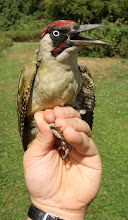
52 birds caught on CES visit 8 at Priory Country Park - an excellent total in a good year let alone in an average/poor year. 26 birds on CES visit 9 was more expected, but did include a juvenile Green Woodpecker.
At Sandy Smith Nature Reserve my last 4 or 5 catches have all been over 50 (with one of 86). Lots of juveniles have been caught including good numbers of Great Tit, Blue Tit and Chaffinch. Juvenile Willow Warblers have been caught as well as a couple of Chiffchaffs. Juvenile Blackcaps have been caught but not in good numbers. Whitethroats have also produced a few juveniles - more than last year, but still numbers are low. A juvenile Jackdaw was a highlight.
One remarkable achievement - including juveniles and adults, I have now ringed/recaptured 16 different Great Spotted Woodpeckers this year! The multiple recapture data is helping construct a good picture of what is happening locally with this species.
I'll restore the picture feed, hopefully, and will have further news soon. Ta ta for now.
The original ringing details for the Siskin I caught in December last year (see here for original blog post) with a Bruxelles ring on it have come through.
It was ringed in Wibrin, Luxembourg, Belgium on 24th February 2012 as an adult female (Euring code 6) and was recaptured by me 288 days later (on 08/08/12) at Sandy Smith Nature Reserve. A movement of 474km in a WNW direction.
I'm pleased with that one.
I always like to attach a few photographs but because of more 'technical issues' I can't share them at the moment. So that has stopped me sharing my other ringing news with you. A quick review of the highlights are:
52 birds caught on CES visit 8 at Priory Country Park - an excellent total in a good year let alone in an average/poor year. 26 birds on CES visit 9 was more expected, but did include a juvenile Green Woodpecker.
At Sandy Smith Nature Reserve my last 4 or 5 catches have all been over 50 (with one of 86). Lots of juveniles have been caught including good numbers of Great Tit, Blue Tit and Chaffinch. Juvenile Willow Warblers have been caught as well as a couple of Chiffchaffs. Juvenile Blackcaps have been caught but not in good numbers. Whitethroats have also produced a few juveniles - more than last year, but still numbers are low. A juvenile Jackdaw was a highlight.
One remarkable achievement - including juveniles and adults, I have now ringed/recaptured 16 different Great Spotted Woodpeckers this year! The multiple recapture data is helping construct a good picture of what is happening locally with this species.
I'll restore the picture feed, hopefully, and will have further news soon. Ta ta for now.
Tuesday, 12 March 2013
A Weekend away
Last weekend I went to see my parents in Gloucestershire. The main reason was to drop off a mothers day card in person (hope you had a good day mum!). The secondary reason was to see my dad and do some ringing at his house on Saturday. Apart from half an hour when I had to close the nets due to rain, I did reasonably well, including adding 3 new species for this site!

Above: An adult male Sparrowhawk. This is the first male I've ringed. Last time I ringed here, a sparrowhawk escaped as I approached the net so it was nice to get one on the next attempt!

Above: A female Siskin. Like a lot of people this winter, my dad is reporting Siskins coming to his garden feeders for the first time ever (he's been there about 20 years). At least one male was around but it firmly decided against carrying a ring on its leg despite flirting with the idea several times!


Above: An adult male Sparrowhawk. This is the first male I've ringed. Last time I ringed here, a sparrowhawk escaped as I approached the net so it was nice to get one on the next attempt!

Above: A female Siskin. Like a lot of people this winter, my dad is reporting Siskins coming to his garden feeders for the first time ever (he's been there about 20 years). At least one male was around but it firmly decided against carrying a ring on its leg despite flirting with the idea several times!

Above: A big, fat Woodpigeon. Enough said!
As well as the 3 new species, a retrap House Sparrow (ringed Nov 2012) was notable as the first retrap of this species (House Sparrows are notorious for being hard to recapture) and as usual for this site, a whole bunch of Blue Tits.
Ringing totals for the day (retraps in brackets)
Blue Tit 18 (7)
Great Tit 3 (1)
Coal Tit 2 (2)
House Sparrow 1 (1)
Woodpigeon 1 (0)
Siskin 1 (0)
Sparrowhawk 1 (0)
Dunnock 2 (2)
Normally I would expect the ratio of Blue Tits to Great Tits to be more even than this, but this area is unusual (at least I think so) in that the number of Blue Tits far outweigh the number of Great Tits.
I've been out strimming grass all week so far for work in far from ideal weather conditions. Strimming will continue until Friday, only punctuated by a day scrub clearing and burning on Thursday. I'm hoping conditions will improve, at the very least by the weekend.
Tuesday, 22 January 2013
My bird ringing in 2012 - Sandy Smith NR review
Top of the bill (no pun intended) at Sandy Smith Nature Reserve (SSNR) for 2012 has to go to:

It was a year with a number of highlights - 11 new species on the ringing list for SSNR, 3 birds ringed elsewhere caught here and 1 bird ringed here caught elsewhere.
Again, the weather played a part in being able to get out and in breeding success for the birds. Whitethroat, in particular, suffered badly from the rain (as I will show later).
In comparing 2011 and 2012, the overall totals do not give a truthful comparison. Overall, more effort went into ringing SSNR in 2012. This came in the form of longer ringing sessions, one or two more nets at times and as I get more proficient at targeting species, numbers of those species have gone up. As an example, Whitethroat numbers were down in 2012 because of poor breeding but Lesser Redpoll numbers jumped this autumn because I had more success with that species.
Total New: 533 Total Retrap: 469 Overall Total: 1002 New for Year: 621 No. of species: 37
2012 Highlights:
The new species were: Brambling (1), Mistle Thrush (1), Starling (3), Linnet (1), Common Redpoll (1), House Martin (1), Goldcrest (8), Jackdaw (1), Magpie (1), Nuthatch (1) & Lesser Spotted Woodpecker (1).
I won't add photographs of all the new species but here are a few of my favourites:


The first controlled bird for this site came in February - it was a Chaffinch originally ringed near Little Fen, South Lopham, Norfolk on 23rd May 2010. Next, a Chiffchaff ringed at SSNR in July was controlled in Letchworth in late August.
And then in December, 2 foreign ringed birds turned up (my first foreign ones): a Blackcap with a Strasbourg ring and a week later, a Siskin with a Brussels ring. This data has been submitted to the BTO and I eagerly await the original ringing details.

I have calculated the amount of effort gone into ringing sessions by counting the hours between first and last capture. This is therefore a minium number as the nets can be up for a while before and after first and last capture.
Total hours in 2012 = 244.25 (38 visits at an average of 6.5 hours per visit) compared to a total in 2011 = 181.25 (36 visits at an average of 5 hours per visit). Fewer new birds were ringed (533) compared to 2011 (693), so the overall total has a greater proportion of retraps.
As for the species:
Apart from Blue and Great Tits that come to the feeding station, Common Whitethroat is the most often ringed species for the site. 2011 was a very good breeding year with 118 birds ringed, but in comparison, 2012 was too wet for them and breeding was largely unsuccessful. Only 6 juveniles were ringed (of 18 new birds) compared to 86 juveniles in 2011 (of 118 new birds). Effort during April to August was 14 visits in 2012 compared to 17 in 2011 so this works out very similar when taking average visit length into account.
More Blackbirds and Song Thrushes were ringed in 2012 as more effort has gone into catching these (apples have worked well).
Despite more effort, fewer Goldfinch have been visiting the feeding station (food has been available on the same basis as 2011).
No Meadow Pipits were caught this year. I did try once, but the conditions weren't ideal. I had two successful attempts in 2011.
No Grasshopper Warblers were ringed this year as none were present in my normal ringing area. At least 2 reeling males were elsewhere on site. 2011 may turn out to have been exceptional as weather conditions in April when they arrived were ideal, whereas 2012 weather was far from ideal. Additionally, some may have, of course, not made it through the winter (where ever they spend it!).
Lastly, longevity records for the site were broken this year. There is nothing spectacular in these and at this stage of the project, it is to be expected. Here are a few selections:
A Great Spotted Woodpecker at 1 year, 348 days.
A Whitethroat at 2 years and 5 days
A Long Tailed Tit at 2 years and 80 days
A Blue Tit at 2 years 26 days
A Great Tit at 2 years 105 days
A Chaffinch at 1 year, 279 days
My first ringing session for the year produced 5 new birds and 5 retraps. A slow start! As I am writing this, I am looking out the window and it is snowing (as it has been all day) so no ringing has been done this weekend). Fingers crossed for next weekend (and the rest of the year!).

Above: Lesser Spotted Woodpecker
It was a year with a number of highlights - 11 new species on the ringing list for SSNR, 3 birds ringed elsewhere caught here and 1 bird ringed here caught elsewhere.
Again, the weather played a part in being able to get out and in breeding success for the birds. Whitethroat, in particular, suffered badly from the rain (as I will show later).
In comparing 2011 and 2012, the overall totals do not give a truthful comparison. Overall, more effort went into ringing SSNR in 2012. This came in the form of longer ringing sessions, one or two more nets at times and as I get more proficient at targeting species, numbers of those species have gone up. As an example, Whitethroat numbers were down in 2012 because of poor breeding but Lesser Redpoll numbers jumped this autumn because I had more success with that species.
Total New: 533 Total Retrap: 469 Overall Total: 1002 New for Year: 621 No. of species: 37
2012 Highlights:
The new species were: Brambling (1), Mistle Thrush (1), Starling (3), Linnet (1), Common Redpoll (1), House Martin (1), Goldcrest (8), Jackdaw (1), Magpie (1), Nuthatch (1) & Lesser Spotted Woodpecker (1).
I won't add photographs of all the new species but here are a few of my favourites:

Above: A House Martin

Above: A Brambling

Above: A Mistle Thrush
The first controlled bird for this site came in February - it was a Chaffinch originally ringed near Little Fen, South Lopham, Norfolk on 23rd May 2010. Next, a Chiffchaff ringed at SSNR in July was controlled in Letchworth in late August.
And then in December, 2 foreign ringed birds turned up (my first foreign ones): a Blackcap with a Strasbourg ring and a week later, a Siskin with a Brussels ring. This data has been submitted to the BTO and I eagerly await the original ringing details.

Above: An adult female Siskin with a Brussels scheme ring on.
I have calculated the amount of effort gone into ringing sessions by counting the hours between first and last capture. This is therefore a minium number as the nets can be up for a while before and after first and last capture.
Total hours in 2012 = 244.25 (38 visits at an average of 6.5 hours per visit) compared to a total in 2011 = 181.25 (36 visits at an average of 5 hours per visit). Fewer new birds were ringed (533) compared to 2011 (693), so the overall total has a greater proportion of retraps.
As for the species:
Apart from Blue and Great Tits that come to the feeding station, Common Whitethroat is the most often ringed species for the site. 2011 was a very good breeding year with 118 birds ringed, but in comparison, 2012 was too wet for them and breeding was largely unsuccessful. Only 6 juveniles were ringed (of 18 new birds) compared to 86 juveniles in 2011 (of 118 new birds). Effort during April to August was 14 visits in 2012 compared to 17 in 2011 so this works out very similar when taking average visit length into account.
More Blackbirds and Song Thrushes were ringed in 2012 as more effort has gone into catching these (apples have worked well).
Despite more effort, fewer Goldfinch have been visiting the feeding station (food has been available on the same basis as 2011).
No Meadow Pipits were caught this year. I did try once, but the conditions weren't ideal. I had two successful attempts in 2011.
No Grasshopper Warblers were ringed this year as none were present in my normal ringing area. At least 2 reeling males were elsewhere on site. 2011 may turn out to have been exceptional as weather conditions in April when they arrived were ideal, whereas 2012 weather was far from ideal. Additionally, some may have, of course, not made it through the winter (where ever they spend it!).
Lastly, longevity records for the site were broken this year. There is nothing spectacular in these and at this stage of the project, it is to be expected. Here are a few selections:
A Great Spotted Woodpecker at 1 year, 348 days.
A Whitethroat at 2 years and 5 days
A Long Tailed Tit at 2 years and 80 days
A Blue Tit at 2 years 26 days
A Great Tit at 2 years 105 days
A Chaffinch at 1 year, 279 days
My first ringing session for the year produced 5 new birds and 5 retraps. A slow start! As I am writing this, I am looking out the window and it is snowing (as it has been all day) so no ringing has been done this weekend). Fingers crossed for next weekend (and the rest of the year!).
Saturday, 8 December 2012
Hot on the heels...
... of the Strasbourg ringed Blackcap last weekend, today I caught a bird with a Brussels ring on! Not a Blackcap this time but one I've been hoping for since I first started catching Siskins at Sandy Smith Nature Reserve (SSNR). Siskins here can prove very elusive when it comes to ringing them.
The area is full of mature Alders and as a consequence, the Siskins a) have lots of natural food and b) stay above net height most of the time.
When I do catch them, it is an entirely random event - the only reason I can offer is that, possibly, a bird of prey (Kestrel or Sparrowhawk) has spooked them whilst they've been near the netting area and have consequently flown lower and left with a ring on. Evidence for this being I've also caught a Kestrel at the same time as my previous highest single round catch of Siskin. This does not hold all the time though as they must come to the feeders occasionally.
Today I caught my highest single round catch ever (2 x 60ft and 1 x 30ft nets only). This also included my single highest round totals of Siskin and Lesser Redpoll.

Above: My ringing station with 40 bird bags, each with a bird in (about 20 birds was my previous high)! At the nets, I was faced with extracting 19 Siskin, 12 Lesser Redpoll + assorted others. It was a big surprise and I had to be quick!
A tip for other ringers who ring out of the back of their cars - I have plastic hooks (upside down so that the hooks are the right way up when the boot is open) stuck on the back window. They need to have very good adhesive and they work remarkably well. 4 for 99p was a very good investment!

Above: The star bird from Brussels - a female Siskin.

Above: One of several male Lesser Redpolls. I've now ringed 61 at SSNR this year.
I have found ringing this year, particularly at SSNR, has been very rewarding. I've added a number of new species to the ringing list for this site such as Lesser Spotted Woodpecker, Nuthatch, Mistle Thrush, House Martin, Brambling & Common Redpoll (there are a few more). Each one has been charming in it's own way and brings back memories. Adding to an already successful day:

Above: A new species ringed at Sandy Smith Nature Reserve - Linnet.

Above: The white in the primary feathers extends to the shaft in males - as in this one above. It had a hint of red on its breast, also indicating it is a male.
The Linnet was caught late on and I am hopeful of ringing more of this species here.
Todays totals are as follows (retraps in brackets):
Great Spotted Woodpecker 1 (0) - the third new one this month
Wren 0 (1)
Dunnock 0 (1)
Blackbird 3 (1)
Song Thrush 2 (0) - 4 this month constitutes a major increase at this site!
Goldcrest 1 (1) - the first retrap for this site therefore a site longevity record!
Blue Tit 5 (10)
Great Tit 0 (1) - I was surprised this was the only one I caught!
Chaffinch 2 (0)
Goldfinch 3 (0)
Siskin 18 (1 foreign control)
Linnet 1 (0) - a first ringing record for the site
Lesser Redpoll 22 (1) - only the second retrapped at this site & will be a site longevity record
Reed Bunting 1 (0)
76 birds - 59 new, 16 retraps and 1 control of 14 species. I now need 55 handlings at SSNR to reach 1000 for the year. It is probably now possible to do this in one visit, though it may well take 2. It's now looking more achievable!
Finally, this Blog is very close to 10,000 page views (only six more to go). I hope all my page viewers have enjoyed reading my mutterings and bird related adventures and will continue to tune in!
Tuesday, 28 February 2012
A rare day!
Ringing at Sandy Smith Nature Reserve this year has been interesting to say the least. Several new species for the site have been ringed (Starling, Brambling, Mistle Thrush). Of these, I am told the Brambling is currently the only known record of this species in Bedfordshire this year so far. Lesser Redpolls have been coming to the feeders, Siskin numbers are way down on last year and the first bird ringed elsewhere (Chaffinch) has been caught at SSNR.
So today I took a day off work and decided to add more chapters to this short story and today's chapter is a rare one!
Numbers wise, it started off slowly and picked up a bit mid morning.

Above: It's always a good day when I catch a Siskin (on the right) or a Lesser Redpoll (on the left) and today these two were in the net at the same time.
For the third time in 3 days, I caught a new species for the site...

Above: A Common (Mealy) Redpoll. All the previous redpoll's I've caught have been of the Lesser variety. If you are unsure on field identification, the easiest way to tell them apart is that Lesser Redpolls are smaller with mostly brown plumage whilst the Common or Mealy Redpoll is larger and mainly grey in colour.
This bird and a Great Tit formed a small and impromtu ringing demonstration to two delighted passers by who took an interest in what I was doing.
After the Common Redpoll, another new species for the site (and for me) was the next bird out of the net and it was a rarity. There are only a handful of birds of this species in the county and are nationally scarce. I have never seen one before and it is a rare day indeed that one is ringed. I am told only 6 have been ringed in Bedfordshire since 1981, the last of which was ringed in 1992 - 20 years ago!

Above: A Lesser Spotted Woodpecker.
I'd always fancied catching one of these at this site since I started ringing there. The River Flit passes through the site and LSW's have been reported up and downstream and within 5 miles of this site. I was only saying to Amanda on Sunday the very same thing! Funny how things work out sometimes!

Above: Lucky git aren't I?!?

Above: A cheeky photograph with the newly installed interpretation board!
A number of Jays were seen. 2 Woodcock were flushed in Upper Alders (wet woodland), lots of fieldfare about, skylarks were singing, 2 buzzards and 2 Little Owls were seen. One that missed the nets (thankfully) was a Pheasant. One that got away was Sparrowhawk - would have been a site first but it extracted itself about two seconds after I realised something large was in the net!
Totals for the day in order of appearance: New (retrap)
Long Tailed Tit 2 (1)
Blue Tit 0 (4)
Robin 0 (1)
Coal Tit 1 (1)
Goldfinch 3 (0)
Great Tit 2 (1)
Wren 1 (0)
Lesser Redpoll 2 (0)
Siskin 1 (0)
Common Redpoll 1 (0)
Lesser Spotted Woodpecker 1 (0)
Chaffinch 2 (0)
Great Spotted Woodpecker 0 (1)
25 birds of 13 species - a good variety.
So today I took a day off work and decided to add more chapters to this short story and today's chapter is a rare one!
Numbers wise, it started off slowly and picked up a bit mid morning.

Above: It's always a good day when I catch a Siskin (on the right) or a Lesser Redpoll (on the left) and today these two were in the net at the same time.
For the third time in 3 days, I caught a new species for the site...

Above: A Common (Mealy) Redpoll. All the previous redpoll's I've caught have been of the Lesser variety. If you are unsure on field identification, the easiest way to tell them apart is that Lesser Redpolls are smaller with mostly brown plumage whilst the Common or Mealy Redpoll is larger and mainly grey in colour.
This bird and a Great Tit formed a small and impromtu ringing demonstration to two delighted passers by who took an interest in what I was doing.
After the Common Redpoll, another new species for the site (and for me) was the next bird out of the net and it was a rarity. There are only a handful of birds of this species in the county and are nationally scarce. I have never seen one before and it is a rare day indeed that one is ringed. I am told only 6 have been ringed in Bedfordshire since 1981, the last of which was ringed in 1992 - 20 years ago!

Above: A Lesser Spotted Woodpecker.
I'd always fancied catching one of these at this site since I started ringing there. The River Flit passes through the site and LSW's have been reported up and downstream and within 5 miles of this site. I was only saying to Amanda on Sunday the very same thing! Funny how things work out sometimes!

Above: Lucky git aren't I?!?

Above: A cheeky photograph with the newly installed interpretation board!
A number of Jays were seen. 2 Woodcock were flushed in Upper Alders (wet woodland), lots of fieldfare about, skylarks were singing, 2 buzzards and 2 Little Owls were seen. One that missed the nets (thankfully) was a Pheasant. One that got away was Sparrowhawk - would have been a site first but it extracted itself about two seconds after I realised something large was in the net!
Totals for the day in order of appearance: New (retrap)
Long Tailed Tit 2 (1)
Blue Tit 0 (4)
Robin 0 (1)
Coal Tit 1 (1)
Goldfinch 3 (0)
Great Tit 2 (1)
Wren 1 (0)
Lesser Redpoll 2 (0)
Siskin 1 (0)
Common Redpoll 1 (0)
Lesser Spotted Woodpecker 1 (0)
Chaffinch 2 (0)
Great Spotted Woodpecker 0 (1)
25 birds of 13 species - a good variety.
Sunday, 20 February 2011
Persistance Pays out, Super Siskins in!
Persistance did indeed pay off today! Having ringed Siskin at Sandy Smith Nature Reserve in November last year, I've been desperate ever since to catch more - but I've drawn a blank every time. That is, until today!

Above: A male Siskin

Above: A female Siskin
There are three factors here, a) the weather conditions must have been right, b) natural food sources could be dwindling and c) they are starting to put on weight for migration. Probably a combination of all three, but which has the greater bearing?
Evidence collected during ringing activities showed that the Siskins aren't storing fat ready for long distance migration (yet - therefore 2 factors are left). I can only make an educated guess that the longer winter goes on, the fewer natural food sources there are (in this case Alder seeds) and that today's weather conditions (on the colder side due to wind chill) meant they wanted an extra food supply (i.e. the nyger seed I provide or in this case my brother provided in the form of a christmas/birthday present).
Totals for today (retraps in brackets): 45 birds of 6 species:
Blue Tit 6 (1)
Great Tit 3 (1)
Chaffinch 1
Long Tailed Tit 16
Goldfinch 2
Siskin 15
I haven't been very successful with Long Tailed Tits over the same period - they moved through the netting area during Autumn but then stopped only to move through today. Interestingly, the two flocks that moved through today did not have any rings on them so are presumably different flocks to those that came through during Autumn. Does that mean that the post breeding but pre-dispersal flocks have moved elsewhere and new flocks have entered the territory?
Flocks of Long Tailed Tits have certainly been around in the intervening period but I have not seen them in the immediate netting area or caught any. Answers on a postcard please! Preferably from the current location of previously ringed Long Tailed Tits and c/o BTO!
Also noted today was the lack of retrap Blue and Great Tits (only 1 each) - where do the new birds keep coming from and where are the old ones? Natural dispersal, feeders elsewhere locally, bad/good weather?
One thing is for sure, with the milder weather we are experiencing, the feeders are taking longer to become empty!

Above: A male Siskin

Above: A female Siskin
There are three factors here, a) the weather conditions must have been right, b) natural food sources could be dwindling and c) they are starting to put on weight for migration. Probably a combination of all three, but which has the greater bearing?
Evidence collected during ringing activities showed that the Siskins aren't storing fat ready for long distance migration (yet - therefore 2 factors are left). I can only make an educated guess that the longer winter goes on, the fewer natural food sources there are (in this case Alder seeds) and that today's weather conditions (on the colder side due to wind chill) meant they wanted an extra food supply (i.e. the nyger seed I provide or in this case my brother provided in the form of a christmas/birthday present).
Totals for today (retraps in brackets): 45 birds of 6 species:
Blue Tit 6 (1)
Great Tit 3 (1)
Chaffinch 1
Long Tailed Tit 16
Goldfinch 2
Siskin 15
I haven't been very successful with Long Tailed Tits over the same period - they moved through the netting area during Autumn but then stopped only to move through today. Interestingly, the two flocks that moved through today did not have any rings on them so are presumably different flocks to those that came through during Autumn. Does that mean that the post breeding but pre-dispersal flocks have moved elsewhere and new flocks have entered the territory?
Flocks of Long Tailed Tits have certainly been around in the intervening period but I have not seen them in the immediate netting area or caught any. Answers on a postcard please! Preferably from the current location of previously ringed Long Tailed Tits and c/o BTO!
Also noted today was the lack of retrap Blue and Great Tits (only 1 each) - where do the new birds keep coming from and where are the old ones? Natural dispersal, feeders elsewhere locally, bad/good weather?
One thing is for sure, with the milder weather we are experiencing, the feeders are taking longer to become empty!
Saturday, 18 December 2010
It'S NOW everywhere!
It's been snowing for 2 hours now and we've got 4 inches I reckon (most of that in the last hour). The most snow I've seen in Bedfordshire in the 4 years I've been here.
I stayed in bed this morning and was in dispair watching the cricket score on teletext. Aussie score going up and up, England wickets falling as quick as the snow is right now!
I didn't wait around to find out what the end of day total was in the cricket, I headed out. First to buy xmas presents (no I'm not telling you what I got) and bird food. Then I fed the birds at Sandy Smith Nature Reserve. I've put out some nijer seed to see if it will attract the siskins (I'm told it should). They'll need the extra source of food right now as natural food will be scarce in this weather.
A month ago there were 150-200 siskins, that dwindled to about 75 last weekend. Today I reckon on 250+. If it wasn't for the weather, I'd be out ringing.
A walk around the reserve yeilded 13 Meadow Pipits, 11 Fieldfare, a few Redwing, 5 Green Woodpeckers, 2 Kestrels, a chaffinch on the newly filled feeders,a mixture of tits (Blue, Great & Long Tailed) and 2 snipe. I heard a Great Spotted Woodpecker and a Jay.
More xmas shopping on the way home and then back home just as the snow was starting to settle on the minor roads.
I checked in with the folks today, Gloucester has had a bit of snow overnight, it thawed a bit in the sun, then they're getting some more. The Cotswolds had a couple of inches in 1 hour this morning, whether they've had any more I don't know but my dad was packing for his flight to Mallorca tomorrow. Good luck dad - I hope the flight isn't cancelled!
I'll phone Southampton now to see if I win the 'who's had the most snow' competition with my brother (he won the other week).
I stayed in bed this morning and was in dispair watching the cricket score on teletext. Aussie score going up and up, England wickets falling as quick as the snow is right now!
I didn't wait around to find out what the end of day total was in the cricket, I headed out. First to buy xmas presents (no I'm not telling you what I got) and bird food. Then I fed the birds at Sandy Smith Nature Reserve. I've put out some nijer seed to see if it will attract the siskins (I'm told it should). They'll need the extra source of food right now as natural food will be scarce in this weather.
A month ago there were 150-200 siskins, that dwindled to about 75 last weekend. Today I reckon on 250+. If it wasn't for the weather, I'd be out ringing.
A walk around the reserve yeilded 13 Meadow Pipits, 11 Fieldfare, a few Redwing, 5 Green Woodpeckers, 2 Kestrels, a chaffinch on the newly filled feeders,a mixture of tits (Blue, Great & Long Tailed) and 2 snipe. I heard a Great Spotted Woodpecker and a Jay.
More xmas shopping on the way home and then back home just as the snow was starting to settle on the minor roads.
I checked in with the folks today, Gloucester has had a bit of snow overnight, it thawed a bit in the sun, then they're getting some more. The Cotswolds had a couple of inches in 1 hour this morning, whether they've had any more I don't know but my dad was packing for his flight to Mallorca tomorrow. Good luck dad - I hope the flight isn't cancelled!
I'll phone Southampton now to see if I win the 'who's had the most snow' competition with my brother (he won the other week).
Sunday, 12 December 2010
2 new species for Sandy Smith NR
The first two birds out of the net this morning at Sandy Smith Nature Reserve were both new species to be ringed on this site. A Great Spotted Woodpecker and a Coal Tit.
In the end, 2 Great Spots were ringed but just the one Coal Tit.

Above: A coal tit.

Above: A Great Spotted Woodpecker
Dunnock 3
Blue Tit 13 (mostly retraps)
Great Tit 3
Coal Tit 1
Great Spotted Woodpecker 2
Chaffinch 1 (2nd of this species ringed on this site)
Robin 1
Siskin 2
26 birds of 8 species.

Above: A female Siskin.
A combination of factors (weather, wind, human error) meant a reduced catch of Siskin today as compared to last time. The flock of Siskin was also smaller than it was (now circa 75 birds - about half the size).
The stonechat was seen again. A curlew was heard (somebody else saw 3 on site in the afternoon). A flock of 25 Redwing went over as did a flock of 12 fieldfare.
A buzzard was heard but not seen. Usually the kestrels are much in evidence hunting nearby. Not today. A jay was heard and the Green Woodpeckers were happily flying around away from the netting area!
The last update on my Bedfordshire ringing (weather permitting) for this calender year should come next weekend. Then it's Gloucestershire ringing.
In the end, 2 Great Spots were ringed but just the one Coal Tit.

Above: A coal tit.

Above: A Great Spotted Woodpecker
Dunnock 3
Blue Tit 13 (mostly retraps)
Great Tit 3
Coal Tit 1
Great Spotted Woodpecker 2
Chaffinch 1 (2nd of this species ringed on this site)
Robin 1
Siskin 2
26 birds of 8 species.

Above: A female Siskin.
A combination of factors (weather, wind, human error) meant a reduced catch of Siskin today as compared to last time. The flock of Siskin was also smaller than it was (now circa 75 birds - about half the size).
The stonechat was seen again. A curlew was heard (somebody else saw 3 on site in the afternoon). A flock of 25 Redwing went over as did a flock of 12 fieldfare.
A buzzard was heard but not seen. Usually the kestrels are much in evidence hunting nearby. Not today. A jay was heard and the Green Woodpeckers were happily flying around away from the netting area!
The last update on my Bedfordshire ringing (weather permitting) for this calender year should come next weekend. Then it's Gloucestershire ringing.
Tuesday, 30 November 2010
Wintering Siskins
Target species aquired! Here's how the story goes:
Weekend no.1: After finding a flock of Siskin c. 150 to 200 strong at Sandy Smith Nature Reserve I set about the task of ringing some. I watched them fly well over the net rides. So I went out and bought some feeders and some food.
Weekend no.2: Feeders up for a week. Birds still flying high over the net rides!
Weekend no.3: Feeders up for a second week, tape lure at the ready. 14 new birds ringed! This was treble the number of siskin I've ever ringed before.

Above & Below: Siskin no.1.


Above & Below: A fistful of Siskin


Above: A green knuckle ride!

Above & Below: The tail shape (pointed) in the photograph above is indicative of a juvenile bird (born this year) whereas the rounded tail shape in the photograph below is that of an adult (born last year or before).

Many of the 14 Siskin caught were males and many of them juveniles. None had rings on, though I am hopeful that I will get some interesting recoveries as there is a good chance of this with Siskins.
Interestingly, the biometrics (wing length & weight) were remarkably similar amongst all the birds (wing length 73 or 74mm and weight around 12.3 or 12.4grams).
See earlier post for other species caught in the same session.
Weekend no.1: After finding a flock of Siskin c. 150 to 200 strong at Sandy Smith Nature Reserve I set about the task of ringing some. I watched them fly well over the net rides. So I went out and bought some feeders and some food.
Weekend no.2: Feeders up for a week. Birds still flying high over the net rides!
Weekend no.3: Feeders up for a second week, tape lure at the ready. 14 new birds ringed! This was treble the number of siskin I've ever ringed before.

Above & Below: Siskin no.1.


Above & Below: A fistful of Siskin


Above: A green knuckle ride!

Above & Below: The tail shape (pointed) in the photograph above is indicative of a juvenile bird (born this year) whereas the rounded tail shape in the photograph below is that of an adult (born last year or before).

Many of the 14 Siskin caught were males and many of them juveniles. None had rings on, though I am hopeful that I will get some interesting recoveries as there is a good chance of this with Siskins.
Interestingly, the biometrics (wing length & weight) were remarkably similar amongst all the birds (wing length 73 or 74mm and weight around 12.3 or 12.4grams).
See earlier post for other species caught in the same session.
Wednesday, 16 September 2009
Buckton
A trip to Buckton with Mark Thomas last weekend was good but was missing a lot of migrant birds. In the end it was too windy & the wind direction wasn't quite right. We had only a handful of migrants all weekend so we did some sea watching on Sunday.

Above & Below: Gannets. There are a lot of Gannets on the cliffs here (way too many to count). Also seen Fulmar & Kittiwakes (at a distance).

We did get some ringing in on Friday & Saturday.

Above: Not a new species for me (I have ringed 1 before) but a new species for the blog. Linnet.

Above: A new species ringed for me and there were two of them. 2 migrant siskins added themselves to my tick list and ringing record. Smashing!

Above: Another ringing tick - Tree Sparrow. Cracking! We caught 7 in total, one of which Mark ringed as a juvenile earlier on in the year (he has ringed over 100 juveniles this year).

Above & Below: Gannets. There are a lot of Gannets on the cliffs here (way too many to count). Also seen Fulmar & Kittiwakes (at a distance).

We did get some ringing in on Friday & Saturday.

Above: Not a new species for me (I have ringed 1 before) but a new species for the blog. Linnet.

Above: A new species ringed for me and there were two of them. 2 migrant siskins added themselves to my tick list and ringing record. Smashing!

Above: Another ringing tick - Tree Sparrow. Cracking! We caught 7 in total, one of which Mark ringed as a juvenile earlier on in the year (he has ringed over 100 juveniles this year).
Subscribe to:
Posts (Atom)