Showing posts with label Control. Show all posts

Tuesday, 22 January 2013

My bird ringing in 2012 - Sandy Smith NR review

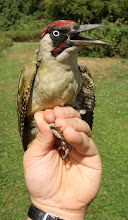
Top of the bill (no pun intended) at Sandy Smith Nature Reserve (SSNR) for 2012 has to go to:


Above: Lesser Spotted Woodpecker

It was a year with a number of highlights - 11 new species on the ringing list for SSNR, 3 birds ringed elsewhere caught here and 1 bird ringed here caught elsewhere.

Again, the weather played a part in being able to get out and in breeding success for the birds. Whitethroat, in particular, suffered badly from the rain (as I will show later).

In comparing 2011 and 2012, the overall totals do not give a truthful comparison. Overall, more effort went into ringing SSNR in 2012. This came in the form of longer ringing sessions, one or two more nets at times and as I get more proficient at targeting species, numbers of those species have gone up. As an example, Whitethroat numbers were down in 2012 because of poor breeding but Lesser Redpoll numbers jumped this autumn because I had more success with that species.

Total New: 533 Total Retrap: 469 Overall Total: 1002 New for Year: 621 No. of species: 37

2012 Highlights:

The new species were: Brambling (1), Mistle Thrush (1), Starling (3), Linnet (1), Common Redpoll (1), House Martin (1), Goldcrest (8), Jackdaw (1), Magpie (1), Nuthatch (1) & Lesser Spotted Woodpecker (1).

I won't add photographs of all the new species but here are a few of my favourites:


Above: A House Martin


Above: A Brambling


Above: A Mistle Thrush

The first controlled bird for this site came in February - it was a Chaffinch originally ringed near Little Fen, South Lopham, Norfolk on 23rd May 2010. Next, a Chiffchaff ringed at SSNR in July was controlled in Letchworth in late August.

And then in December, 2 foreign ringed birds turned up (my first foreign ones): a Blackcap with a Strasbourg ring and a week later, a Siskin with a Brussels ring. This data has been submitted to the BTO and I eagerly await the original ringing details.

Above: An adult female Siskin with a Brussels scheme ring on.

I have calculated the amount of effort gone into ringing sessions by counting the hours between first and last capture. This is therefore a minium number as the nets can be up for a while before and after first and last capture.

Total hours in 2012 = 244.25 (38 visits at an average of 6.5 hours per visit) compared to a total in 2011 = 181.25 (36 visits at an average of 5 hours per visit). Fewer new birds were ringed (533) compared to 2011 (693), so the overall total has a greater proportion of retraps.

As for the species:

Apart from Blue and Great Tits that come to the feeding station, Common Whitethroat is the most often ringed species for the site. 2011 was a very good breeding year with 118 birds ringed, but in comparison, 2012 was too wet for them and breeding was largely unsuccessful. Only 6 juveniles were ringed (of 18 new birds) compared to 86 juveniles in 2011 (of 118 new birds). Effort during April to August was 14 visits in 2012 compared to 17 in 2011 so this works out very similar when taking average visit length into account.
More Blackbirds and Song Thrushes were ringed in 2012 as more effort has gone into catching these (apples have worked well).

Despite more effort, fewer Goldfinch have been visiting the feeding station (food has been available on the same basis as 2011).

No Meadow Pipits were caught this year. I did try once, but the conditions weren't ideal. I had two successful attempts in 2011.

No Grasshopper Warblers were ringed this year as none were present in my normal ringing area. At least 2 reeling males were elsewhere on site. 2011 may turn out to have been exceptional as weather conditions in April when they arrived were ideal, whereas 2012 weather was far from ideal. Additionally, some may have, of course, not made it through the winter (where ever they spend it!).

Lastly, longevity records for the site were broken this year. There is nothing spectacular in these and at this stage of the project, it is to be expected. Here are a few selections:

A Great Spotted Woodpecker at 1 year, 348 days.
A Whitethroat at 2 years and 5 days
A Long Tailed Tit at 2 years and 80 days
A Blue Tit at 2 years 26 days
A Great Tit at 2 years 105 days
A Chaffinch at 1 year, 279 days

My first ringing session for the year produced 5 new birds and 5 retraps. A slow start! As I am writing this, I am looking out the window and it is snowing (as it has been all day) so no ringing has been done this weekend). Fingers crossed for next weekend (and the rest of the year!).

Friday, 18 January 2013

My bird ringing in 2012 - Priory CP Review

Well, the weather made it a tough year - and not just for me - for the birds too. Massive amounts of rain over the spring and summer meant breeding was not very successful for most species, but those that could find enough food (Blackbird being one of them) did well. A few planned ringing sessions got cancelled too but I found enough gaps inbetween the wet and windy spells to put more effort in than last year.

The Constant Effort Scheme was operated again (it has been going for 20 years now). Unlike many other people who take part in this scheme across the country, I was among the few who completed all 12 timed visits (plus a couple of extra).

Some effort was put in trying to catch House Martins and Swallows next to the main lake. However, several attempts proved a complete failure. Not a single bird of any species were caught! Unusually low numbers of hirundines (swallows & martins) were passing through on return migration after a poor breeding year and this, along with perhaps choosing a poor site for catching these species, left me scratching my head. There's always next year!

It was my intention to ring at a feeding station during the autumn/winter. New, squirrel proof feeders were required and duly bought. They had been up about a month before they disappeared. It was quite a while before I found 1 and a half of them deep in the brambles. The other 1 1/2 are out there somewhere I'm sure. However, given their disappearance and the cost of replacing them, the feeding station idea was abandoned for this winter.

Total birds handled at Priory CP in 2012 were as follows:

Total New: 640 Total Retrap: 346 Overall total: 986 New for year: 767 No. of species: 33

A species list (along with no.'s of each caught in 2012 can be found on the Priory Country Park page of this blog or by clicking here).

Of special note are the following:

1. A Corn Bunting was ringed (the first at Priory since 3 were caught and ringed in 1991). This was a new species for me and more effort will go into catching this species in the future. Corn Buntings are on the decline and their conservation status in the UK is RED because of a historical decline in numbers and more recently, a breeding population decline. They are hard to catch and I doubt that many have been ringed in Bedfordshire - there has definitely been no recoveries of this species in Bedfordshire as the BTO online ringing reports confirm. However, there will be more about this species in a later post...


Above: A Corn Bunting

2. Only the second Kestrel to be ringed at Priory was caught in 2012. Unusually, the bird was frequenting the area around the ringing site and perching low down in the trees. The first was ringed in 2003.

3. Only the second Jay to be ringed at Priory was caught this year (the first was ringed in 2000). This year was unusual in that there was an 'erruption' or mass migration of Jays across the country. Record numbers were being observed migrating. There is conjecture as to whether these birds are foreign or british ones, however I have read that there is no evidence to support that these were foreign birds.

4. Lesser Redpolls - previously a total of only 9 had been ringed at Prioy before 2012. However, effort has gone into ringing this species and a total of 28 individuals were ringed in 2012. In addition, the first Lesser Redpoll of the year here was a control (i.e. somebody else's ring!). I am eagerly awaiting the original ringing details of this bird.


Above: The controlled Lesser Redpoll

Recoveries:

Blackcap: Ringed in Sept 2011 at Priory, this bird was captured at Grafham Water in May 2012 - presumably it was breeding there.

A Mallard ringed on the Embankment in 2003 was found dead at Priory in March 2012.

Awaiting details of the control Lesser Redpoll.

Details of the controlled Goldcrest from December 2011 came through this year, it was ringed at Flamborough Head (East Yorkshire) in September that year.

Now for the down side - most species didn't manage a good breeding season. I haven't delved too deeply yet into the data as I have a lot of background work to do before I can say anything with confidence, however the totals were down on 2011 for most species. In the wet weather, most species would find their food sources washed off the leaves (e.g.. caterpillars that the Tits feed on) however a few might find more food (e.g. more worms for the Blackbirds).The national preliminary CES results can be found here.

For the first time in 22 years, no Willow Warblers were caught at Priory.

Ringing in Priory Country Park has started for 2013. News will be posted in due course. Here's to a good year (he writes as it snows!).

Saturday, 1 December 2012

Are winter Blackcaps from the continent?

Having blogged in previous posts about catching a couple of winter Blackcaps recently. Our overwintering population of Blackcaps are thought to be continental in origin rather than being part of the summer population overstaying.

Perhaps the control juvenile female Blackcap I caught today at Sandy Smith Nature Reserve has something to add to this story. I can't show you as I didn't have my camera, but it had a Strasbourg ring on!

So it was hatched this year (on pointy tail shape for you ringers) and has moved roughly in a North Westerly direction since it was ringed, to find itself in the heart of Bedfordshire, England. And that's all I can tell you about my first self caught foreign ringed bird.

Totals today amounted to 55 birds (22 new and 33 retrap) of 13 species (retraps in brackets)

Great Spotted Woodpecker 2 (0)
Wren 1 (0)
Dunnock 1 (1)
Robin 1 (1)
Blackbird 4 (0)
Song Thrush 2 (0)
Blackcap 0 (1) A control from the 'Strasbourg' area!
Long Tailed Tit 0 (1)
Blue Tit 3 (18)
Great Tit 2 (10)
Chaffinch 0 (1)
Goldfinch 2 (0)
Lesser Redpoll 4 (0)

In my last post, I told you that I needed 186 handlings to beat my 2011 total for Sandy Smith Nature Reserve. After today, I need 131. If I'm lucky I can do that in 3 sessions, and if that luck holds, I can fit those 3 sessions in before the end fo the year. I'm still hoping!

Wednesday, 18 April 2012

Going away...

I'm off on travels on Thursday. Hoping for some decent birds and great photographs from a trip to Extremadura (Spain) - some of which I will share with you in May.

When I get back, it will be straight back into work and then the CES ringing season starts.

Recent ringing has seen me at Priory Country Park - a pre CES session producing 27 birds including Dunnock, Wren, Blue Tit, Great Tit Chaffinch, Blackbird, Chiff Chaff (4) and Blackcap (8). One Blackcap was a male bird first ringed here last year on 20th July.

It has been slow at Sandy Smith Nature Reserve with catches of 8, 7 and 4. The Magpie you will have seen a picture of in a previous post. Otherwise, last weekend (15th) I was hoping for but didn't get the first Whitethroats and Grasshopper Warblers as they were both present on the 16th April last year. The weather has been different this year though and is apparently delaying the arrival of some species.

Other recent news is of a Goldcrest control trapped on 17th Dec at PCP - it was first ringed on 10/09/11, at Flamborough Head, East Yorkshire! 98 days, 221km south.
Nice one!