Showing posts with label Spotted Flycatcher. Show all posts

Wednesday, 24 September 2014

Wagtail delight

In the period since my last post, I have been busy ringing (and entering data!) but the numbers ringed haven't topped the heights of August. However, quality has been in evidence.
 
We are well into peak migration time for our summer breeders. Some species are largely gone already, whilst some are still in full flow and Blackcap migration seems to have peaked already but will continue for a little while yet.
 
At Sandy Smith Nature Reserve (SSNR) I've caught a couple of late Reed Warblers (12/09/14), a late Sedge Warbler (13/09/14) and 15 Blackcaps so far in September. Favoured natural food for Blackcaps are the purple Elderberries which have been in abundance in my ringing area - though it was noted the other day that the berries are wilting & dying (perhaps because of age, perhaps continued heat!). 10 Chiffchaffs have accompanied the tit flocks so far in September and just 1 Whitethroat has made an appearance (compared to 3 in 2013, 0 in 2012, 4 in 2011 and 4 in 2010).
 
And then there's the quality:


Above & Below: A juvenile Yellow Wagtail.

 
A flock of Yellow Wagtails were in amongst the sheep and cattle on SSNR. A roost session produced just the 1 bird - the first of this species ringed here. The site list is now up to 50 species ringed, with one other species - Mute Swan - ringed elsewhere.
 
The main species missing from the ringing list  at SSNR (because they haven't been targeted and might prove more difficult to catch) are Skylark, Woodpigeon, Snipe, Swallow, Stonechat and Whinchat.

The following day, in my usual ringing area, a surprise in the nets (it wasn't seen beforehand) was:


Above: A juvenile Spotted Flycatcher (3rd ringed on site following singles in 2011 & 2013).

On Monday 22nd, on a walk around the reserve, a large number of Meadow Pipits were observed (50+), as were a number of Skylarks but best of all - 2 Stonechats in the mist (they were gone by lunch time). I later observed a fox at quite a distance, hunting for food in broad daylight.

My other site - Priory Country Park (PCP) - has been producing good numbers too now that the CES restrictions are lifted. In September, of the migrants, we've ringed 3 more Reed Warblers, 36 Blackcap, 18 Chiffchaff and 2 Willow Warblers. Of the birds coming to the feeding station, 42 have been new Blue Tits and 37 of the Great Tit variety whilst 11 have been Chaffinches. Our first two juvenile Bullfinches of the year were ringed too - surprising that we didn't ring any juveniles during the CES season.

I have commented previously that it has been a good year for Goldcrest - 6 juveniles have been ringed this month so far at PCP (making 10 for the year).

It won't be long now until we are graced with species that migrate to our country to spend winter with us (some may already be here). I personally look forward to Lesser Redpoll and Siskin migration most. Lets hope for favourable weather to bring them to our shores!

I hope to run another ringing session at Priory on Sunday 28th September - with a demonstration for the Guided Bird Walk - meeting 9am at the visitor centre.

Sunday, 22 September 2013

A lengthy round up!

Firstly, a quick note to say sorry about the incorrect formatting on my last post - I don't know what Blogger did, but it certainly wasn't written in one big block!

It's been a while since I posted some photogrpahs and accounts of my ringing activities. I have been out ringing, in between scattering my Dad's ashes, dealing with his stuff, bad weather and taking well earned rests!

Scattering my Dad's ashes went as well as could be hoped for. Everything went smoothly, it didn't rain although the clouds did look threatening! My dad would have liked the moody skies, the location, how we did it and that we were joined by a pair of Ravens, a Sparrowhawk and with near perfect timing and as I'd hoped, just after the last scattering - a Red Kite. He would have liked that too.

I also did some ringing at my dad's house. There were few birds about but I did manage to catch 20+ House Sparrows (more than I've ringed there before in total) and a new species - Chiffchaff. Elsewhere, however, the best day started thus:


Sunrise at Sandy Smith Nature Reserve, above, on 20th August 2013. The sunrise was good as I drove into the site but as I walked round the corner carrying my equipment, I had one of those moments where you just have to stop and say 'wow' and drink in the beauty of the moment.

The day continued well with 78 birds in total (retraps in brackets):

Great Spotted Woodpecker 0 (1)
Dunnock 4 (1)
Robin 3 (1)
Whitethroat 3 (0)
Blackcap 3 (0)
Chiffchaff 4 (1)
Willow Warbler 6 (0)
Coal Tit 1 (0)
Blue Tit 5 (13)
Great Tit 3 (20)
Chaffinch 3 (1)
Goldfinch 4 (0)

and best of all...


Above: Spotted Flycather (2nd ringing record for the site, previous being in 2011). A juvenile, presumably on migration or a local roaming around.

A session previous to this, on 10th August, again at Sandy Smith NR, exactly 100 birds were caught of 14 species:

Wren 4 (1)
Dunnock 3 (2)
Robin 1 (1)
Reed Warbler 1 (0) - 2nd this year and only the third ringed for the site
Whitethroat 8 (1)
Blackcap 3 (1)
Chiffchaff 9 (0)
Willow Warbler 2 (0)
Long Tailed Tit 3 (1)
Marsh Tit 1 (0) - only 3rd ringed for the site
Blue Tit 8 (8)
Great Tit 7 (29)
Treecreeper 1 (0)
Chaffinch 4 (1) - there are a LOT of juv chaffinches this year!


Above: Marsh Tit

It's been an interesting year so far at SSNR. New for year totals of Great Spotted Woodpecker, Chiffchaff, Willow Warbler, Goldcrest, Long Tailed Tit, Coal Tit, Great Tit, Treecreeper and Chaffinch are all higher than in previous years (operating since 2010) whilst Redwing and Jay have been added to the ringing list this year.

Last year, I set myself a goal of reaching 1000 captures at SSNR for the year (and just made it). This year, I have been keeping tabs on my progress and (adding yesterdays total of 41) I have reached 870 captures (of 30 species), putting me ahead of schedule in comparison to the previous two years.

Breaking this down into effort, I reckon I've had 1 or 2 more nets up and they've been up for longer rather than making more visits. I've also got wiser about the catching some species, but then some species are more abundant this year and some are less so. So, a bit of swings and roundabouts then!

Before reaching 1000 for this year though, I think the next milestone will be the 2000th new bird ringed as 39 more new birds are needed for this.

A quick mention for Priory Country Park - with the help of other members of the Ivel Ringing Group & visitors, we completed all 12 visits of the Constant Effort Survey. I haven't studied the results in any depth but I can tell you that overall, this is one of the worst recorded years since it started in 1992. I will put something up soon about this on the Ivel Ringing Group Blog.

Lastly, I can now share a photograph with you from a ringing session on 7th July, 2013. 


Above: A Juvenile Jackdaw

This is the second Jackdaw (both juveniles) ringed at SSNR following one last year (when I didn't have my camera with me). This was caught on the day my dad passed away. A day which, apart from the obvious, was a perfectly nice and enjoyable day.

Sunday, 4 September 2011

Just another days ringing...

David Howes & I went to Sandy Smith Nature Reserve yesterday (03/09/11) with the main aim of ringing Blackcaps (there are lots on passage at the moment) and to try something new.

I wasn't sure it was going to work, but nothing ventured nothing gained.

Having seen before how to catch Meadow Pipits and having bought new nets especially (nets of the same lenght being a requirement for this to work) I sussed out where best to put the nets the night before. It was time to test my skills.

The wind wasn't a problem when we arrived so we set about erecting nets, however the ground was very hard and it was proving difficult to put the guy poles in the ground. We found a brick and ended up bashing them in (even that was difficult!).

My ringing license permits me to use tape lures, so on went the tape and the wait started. Were there any Meadow Pipits about we wondered?

More waiting.

We went back to my car for something and on our return, hey presto - Meadow Pipits arriving, landing on the top of the net, on top of the poles and on the guy ropes! One mad dash later and..


Above: One of 3 Meadow Pipits ringed - new to my self caught list and new species ringed for the site.

With there being a lack of Meadow Pipits coming back after the first round, we put nets up elsewhere - a 30ft in amongst some plum trees (this net caught nothing but leaves and twigs!) and a 60ft in some ash regeneration near the wood with all the plum trees.

These nets weren't doing particularly well either to begin with, and going back to the Meadow Pipits, there were none so having passed the skills test it was time to concentrate on Blackcaps.

Wren - and that was it for that net round! However whilst David was extracting the Wren (that's what helpers are for after all!), my attention was drawn to an area dripping with birds (Goldfinch, Green Woodpeckers, different varieties of Tits and a species that I couldn't quite see properly to clinch the ID though I had a good idea). Wren extracted and we both looked and said - we can get a net in there between the teasels and the trees (Plum, Elder, Hawthorn etc.), so we erected a 60ft and 30ft jap net in a dog leg around the corner where all these birds were - the emphasis on were because they disappeared when we went to put the nets up!

So we left the nets alone to see what was happening. 15 minutes later and I went for a sneak peek - a few birds were in the 60ft in the ash regeneration. A net with a bird in is never bad news. A Marsh Tit was seen hanging around nearby too. Another 15 minutes later and we went back to find nearly 20 birds in that net! Mostly Blackcap, a couple of Chiff Chaffs, a Robin, a Whitethroat.

Extraction began - half way through my attention was drawn to a Green Woodpecker noisily flying out from the teasels, staying low, towards the net. Still low enough, still towards the net - RUN! I wasn't going to give this a chance to get out of the net. Approaching 2 more were already in the net!


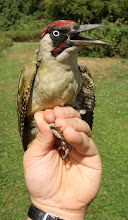
Above: 2 Green Woodpeckers - a new species ringed for the site. Sadly, one got out of the net before I could get to it. I shall remember for the future now I know where to go to catch them! There are lots on site.

This was turning out to be a great day. A couple of Goldfinch, another Blackcap, a Long Tailed Tit and one other bird made these 2 extra nets productive.

David ringed most of the birds - I just took a Green Woodpecker and one or two others to keep me happy whilst I scribed. However the last bird from the round was for me:


Above: A juvenile Spotted Flycatcher! This is only the second species I have never ringed before and caught myself (the first being Grasshopper Warbler). Needless to say, the 3rd species new for the site on this really really great day!


Above: The Spotted Flycatcher from the front.

Having now cleared the area of the majority of birds, we were left with a few Wrens to punctuate the waiting.

We gave up eventually at around 1.30pm. Gathering up all the equipment we were walking back to the cars when my eyes caught sight of a bird that appeared to come out of a rabbit hole! This rabbit hole was in the hollow dug out by The Greensand Trust to create a bee habitat (the geology is greensand & therefore the ground is very sandy). We got the binoculars out and identified the bird but could we turn this ordinary day (ha ha) into a spectacular day?

After making sure it wasn't going to be a waste of time, a net was hastily erected and 5 minutes later (that included a bit of jumping for joy) I was ringing this:


Above: The birds 'armpit' feathers.


Above: The birds tail.


Above: I'm ring the bird. Know what it is yet?


Above: It's a Wheatear. It was carrying some fat - a bird on passage. There aren't many birds of this species that have been ringed in Bedfordshire.


Above: A happy very chappy. My 3rd self caught ringing tick, hot on the heels of number two! And the 4th new species ringed for the site in one day. A spectacular day complete.


Above: This post however, wouldn't be complete without a picture of David. Thanks for helping and I couldn't have done it without you. A learning experience for both of us.

Sunday, 22 May 2011

Sardinia birds 2

There are a lot of suitable sites to watch birds in Sardinia but you have to travel to get a wide range of species. And travel takes time in Sardinia. We could only find 1 to 200000 scale maps (OS maps are 1 to 25000 in the UK) and these weren't that helpful by not showing all the roads!

When the map indicated that the route we wanted to take was going straight on through a town, we often found that due to chaotic one way systems, the actual route was far from straight forward. The lack of signs at major junctions was also not very helpful. And I don't recommend short cuts as you'll soon find yourself lost!

Wildlife tourism here is possible, it's just that signage, directions in literature and information are often hard to come by. Knowing enough Italian to ask for directions & understand them is essential!

Species such as Spanish Sparrow and Hooded Crow were very easy. But Crag Martin and Citril Finch took some travelling to find (slow going up & down those mountain roads) although this may have been just a result of the places we chose to travel to!


Above: A Woodchat Shrike.


Above: Spotted Flycatcher. Whilst sitting in the picnic/cafe area of a 'cultural location', a pair of Spotted Flycatchers were flitting around very close by. It was rude not to take a photograph!


Above: A Wheatear. I only saw this species above the tree line whilst walking up to the top of the highest mountain in Sardinia.


Above: Citril Finch. Again, only recorded above the tree line whilst walking up to the top of the highest mountain in Sardinia. It took us a long time to drive there, but once parked, it took only a minute to find these small finches.


Above: Funny story - the first species I saw on the holiday was a Starling. The plane had been on the ground less than a minute! But it was bothering me for several days. I kept on seeing Starlings but in my mind, I was questioning this ID. "They're a bit black" I was saying to myself. "They can't be blackbirds can they? No, I'm sure they're Starlings." But I'd not seen them up close because when I saw them, I/we were driving and they were at a distance. Anyway, when I finally looked up Starling in the book I found there was such a thing as Spotless Starling! My mind was easier but it still took a day or two to 'spot' one and confirm their spotlessness. The photograph (above) doesn't really show it very well.


Above: Hooded Crow. My holiday was punctuated with many shouts of 'what's that Edward?' My standard reply was - another Hooded Crow dad!


Above: Jackdaw. Whilst the hooded crow was common, this was only one of 2 Jackdaws seen (the other being at the same time as this one). The Hooded Crow (pictured above) and this Jackdaw were vying for position on the telegraph pole.


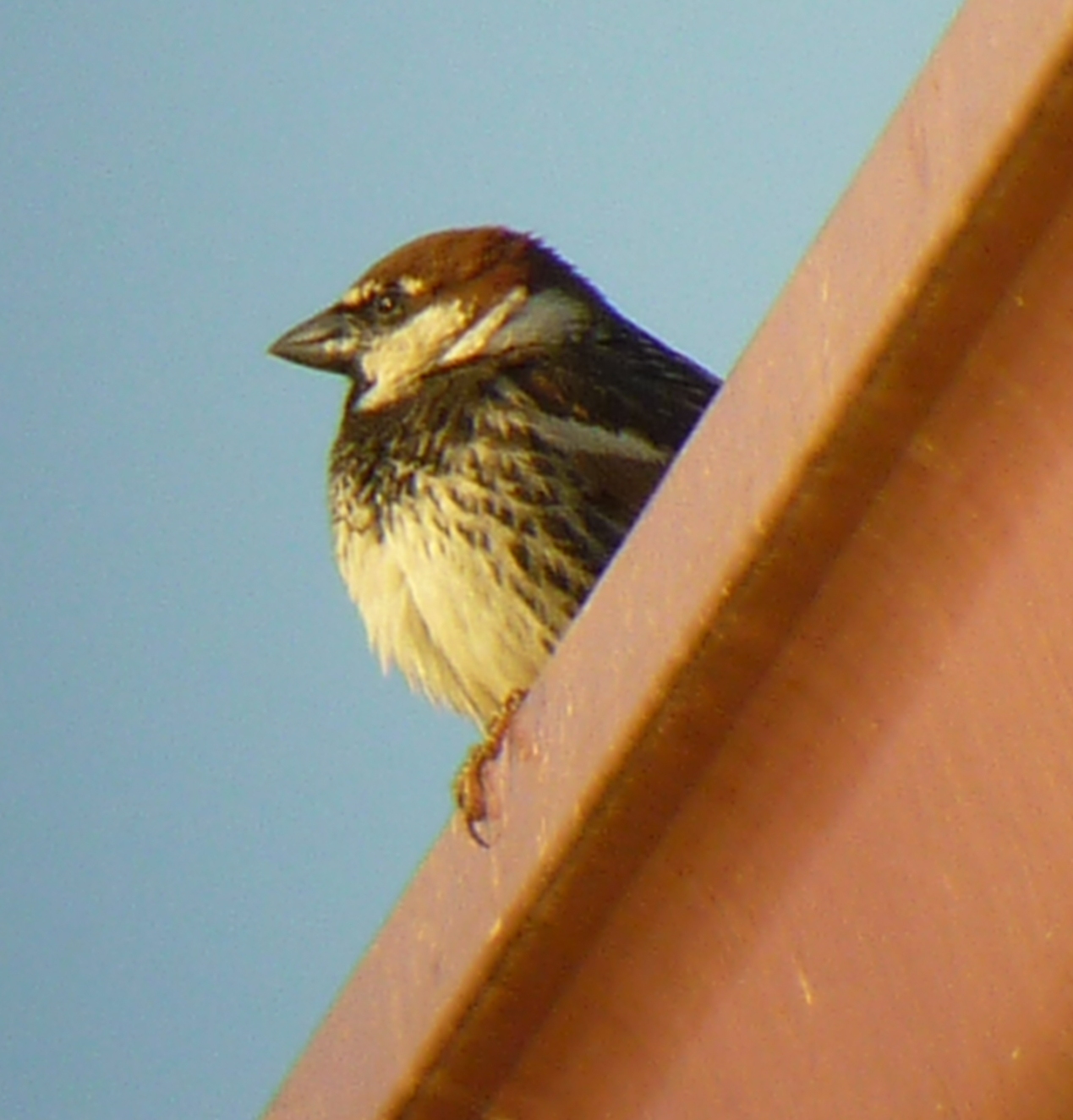
Above: Spanish Sparrow - this bird was one of many nesting in the roof of our hotel. They were everywhere and were by far the most recorded species on the holiday.

More to come yet!