Showing posts with label House Martin. Show all posts

Tuesday, 22 January 2013

My bird ringing in 2012 - Sandy Smith NR review

Top of the bill (no pun intended) at Sandy Smith Nature Reserve (SSNR) for 2012 has to go to:


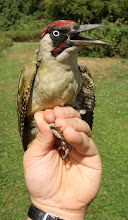
Above: Lesser Spotted Woodpecker

It was a year with a number of highlights - 11 new species on the ringing list for SSNR, 3 birds ringed elsewhere caught here and 1 bird ringed here caught elsewhere.

Again, the weather played a part in being able to get out and in breeding success for the birds. Whitethroat, in particular, suffered badly from the rain (as I will show later).

In comparing 2011 and 2012, the overall totals do not give a truthful comparison. Overall, more effort went into ringing SSNR in 2012. This came in the form of longer ringing sessions, one or two more nets at times and as I get more proficient at targeting species, numbers of those species have gone up. As an example, Whitethroat numbers were down in 2012 because of poor breeding but Lesser Redpoll numbers jumped this autumn because I had more success with that species.

Total New: 533 Total Retrap: 469 Overall Total: 1002 New for Year: 621 No. of species: 37

2012 Highlights:

The new species were: Brambling (1), Mistle Thrush (1), Starling (3), Linnet (1), Common Redpoll (1), House Martin (1), Goldcrest (8), Jackdaw (1), Magpie (1), Nuthatch (1) & Lesser Spotted Woodpecker (1).

I won't add photographs of all the new species but here are a few of my favourites:


Above: A House Martin


Above: A Brambling


Above: A Mistle Thrush

The first controlled bird for this site came in February - it was a Chaffinch originally ringed near Little Fen, South Lopham, Norfolk on 23rd May 2010. Next, a Chiffchaff ringed at SSNR in July was controlled in Letchworth in late August.

And then in December, 2 foreign ringed birds turned up (my first foreign ones): a Blackcap with a Strasbourg ring and a week later, a Siskin with a Brussels ring. This data has been submitted to the BTO and I eagerly await the original ringing details.

Above: An adult female Siskin with a Brussels scheme ring on.

I have calculated the amount of effort gone into ringing sessions by counting the hours between first and last capture. This is therefore a minium number as the nets can be up for a while before and after first and last capture.

Total hours in 2012 = 244.25 (38 visits at an average of 6.5 hours per visit) compared to a total in 2011 = 181.25 (36 visits at an average of 5 hours per visit). Fewer new birds were ringed (533) compared to 2011 (693), so the overall total has a greater proportion of retraps.

As for the species:

Apart from Blue and Great Tits that come to the feeding station, Common Whitethroat is the most often ringed species for the site. 2011 was a very good breeding year with 118 birds ringed, but in comparison, 2012 was too wet for them and breeding was largely unsuccessful. Only 6 juveniles were ringed (of 18 new birds) compared to 86 juveniles in 2011 (of 118 new birds). Effort during April to August was 14 visits in 2012 compared to 17 in 2011 so this works out very similar when taking average visit length into account.
More Blackbirds and Song Thrushes were ringed in 2012 as more effort has gone into catching these (apples have worked well).

Despite more effort, fewer Goldfinch have been visiting the feeding station (food has been available on the same basis as 2011).

No Meadow Pipits were caught this year. I did try once, but the conditions weren't ideal. I had two successful attempts in 2011.

No Grasshopper Warblers were ringed this year as none were present in my normal ringing area. At least 2 reeling males were elsewhere on site. 2011 may turn out to have been exceptional as weather conditions in April when they arrived were ideal, whereas 2012 weather was far from ideal. Additionally, some may have, of course, not made it through the winter (where ever they spend it!).

Lastly, longevity records for the site were broken this year. There is nothing spectacular in these and at this stage of the project, it is to be expected. Here are a few selections:

A Great Spotted Woodpecker at 1 year, 348 days.
A Whitethroat at 2 years and 5 days
A Long Tailed Tit at 2 years and 80 days
A Blue Tit at 2 years 26 days
A Great Tit at 2 years 105 days
A Chaffinch at 1 year, 279 days

My first ringing session for the year produced 5 new birds and 5 retraps. A slow start! As I am writing this, I am looking out the window and it is snowing (as it has been all day) so no ringing has been done this weekend). Fingers crossed for next weekend (and the rest of the year!).

Sunday, 1 July 2012

Sandy Smith NR - a new species ringed

I've been unable to visit Sandy Smith Nature Reserve much recently, largely due to the weather being miserable. More info about a visit on Tuesday 26th June can be found on the Ivel Ringing Group blog here. This ringing session brought the first juvenile Sedge Warblers, Whitethroats, Blue/Great Tits, Great Spotted Woodpecker and Chaffinches we also caught 2 Starlings (only the 2nd & 3rd ringed here) - a ringing tick for David.

A visit this morning (Sunday 1st) produced more new juveniles including the first juvenile Wren of the year here but was interesting in a different way. The last catch produced:


Above: A Kestrel - the second to be ringed at SSNR.

A single House Martin was the best bird. A first for the site and also a ringing tick for me. A group had been skimming around low down all morning long (including some Swallows) in the area.


Above: An adult House Martin. A female as it had a brood patch that appeared to be reducing (B3 on its way to B4).

These House Martins aren't usually to be found feeding like this on the reserve until later in the year so I am speculating that these have finished breeding (I don't know if there were any juveniles amongst the flock). This was an accidental catch as they are not normally caught in mist netting activities unless targeted. I was lucky one made a mistake - others flew over the top of the nets!

Tuesday, 8 May 2012

Birds from Extremadura, Spain


Having had problems with my internet connection, I have been unable to post any of my photographs taken on a recent holiday to Extremadura, Spain. Though I have been able to edit them in preparation. The situation has improved... slightly... so here you go (do click on the photographs to see larger versions & the species names below are also given in Spanish for Antonio Calvo):


Above: A party of House Martins (Avíon común) collecting mud for their nest building. This species is common in Spain. There were many places where I found them and there were large colonies - under bridges/dams especially. One very long bridge had hundreds of nests under various stages of constant construction - on both sides!


Above: Gulp! A swallow, but not the Barn Swallow type that we see in Britain regularly during the spring/summer but a Red-rumped swallow (Golondrina daurica). N.B. Britain sees a handfull of the red-rumped type each year. Smaller than a Barn Swallow, the red/white rump and the red neck also make this bird stand out. This bird was photographed at Monfrague National Park.

Not too widespread but not too hard to find in Extremadura.


Above: Up the crag without a paddle? Well these Crag Martins (Avíon roquero) seemed to be doing ok! Presumably taking a rest from feeding (they weren't nesting on this ledge), I was able to get fairly close from a bridge above them. I saw some in Sardinia last year but I got better views this time!


Above: Having now seen these photographs up close, I am struck by how similar they are to swifts (in their wing feathers and beak structure), at least sitting - they look different in flight. They are built for catching insects on the wing.

The holiday itself was good. Though you won't want to hear it, the weather was better in Spain than in the UK! It did rain quite a bit towards the end (snow on the top of the mountains) but overall we did well. Over 100 species were seen and about a quarter were species I'd never seen before.

For those of you who might be interested, the bird photographs from Spain posted here (and in future posts) will have been taken with a Cannon EOS 1000D and a Cannon EF 400mm 1:5.6L lens.

Wednesday, 19 May 2010

Menorca Birds 2010 Edition 6 + Drain Pipes ... of course!

We went for a walk from Cala Galdana up Algendar Gorge (having already done part of the gorge from the other end where I got photographs of the Egyptian Vulture). We were aware that this was a great place to go for migrating birds but missed this on our visit last year.

I didn't find anything spectacular, or add anything to my holiday list but I did get some good photographs.


Above: A Sand Martin. I tried to find a crag martin during the holiday - unsuccessfully.


Above: Lots of house martins resting in a Tamarisk tree after an arrival.

The weather wasn't great but as the water droplets came down with increasing regularity, I noticed a significant arrival of House Martins on the way back to the car that weren't there on the first pass. Numbers must have been around the 4 figure mark.

Last year, whilst walking around I noticed a variety of 'interesting' (to me anyway)drainage solutions.


Above & Below: These are both the same house.


Below: This one was not such a good example. It is draining water from a balcony above but is clearly staining the wall. Most buildings in Menorca are white and I reckon they must sell billions of litres of white paint every year!


Below: Somebody with a sense of humour, although technically, I don't think it would be draining water from anywhere!