Sunday, 14 April 2013

A bit of Green & Red

Quality rather than quantity at Sandy Smith Nature Reserve yesterday before the wind stopped all ringing for the weekend (again).

7 captures:

Blue Tit = 1 retrap
Dunnock = 1 new
Chaffinch = 2 retraps
Green Woodpecker = 1 new
Goldfinch = 1 new
Coal Tit = 1 new


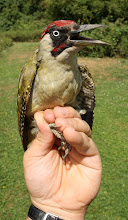
Above: An adult male Green Woodpecker


Above & Below: That same Green Woodpecker. I do think they are marvelous birds. The red in the malar strip (below the eye, surrounded by black) makes this a male.


I love these close up head photographs of birds in 'the ringers grip'. They make great computer backgrounds!

The last two weekends, I've seen the Green Woodpeckers bombing around chasing each other all over the place, high and low, through the trees, over the grassland, onto the BT poles. It's either a terratorial thing (e.g. male chasing male) and/or a breeding thing (e.g. male chasing female).


Above & Below: A Goldfinch. The facial red showing behind the eye and black nasal hairs make it a male. I mentioned in my last post it was nice to catch the first two of the year & this was the third.


I didn't take a photograph of it but the final bit of quality was a new Coal Tit. A Chiff Chaff was singing briefly from the tops of the trees and a lone swallow was seen heading east but that was it for summer migrants. Elsewhere on the reserve a Yellowhammer was hanging around. Some Fieldfare (around 20) were also knocking around.

Unless I get some recoveries through, my next post will be in a few weeks time with photographs from Sardinia and/or CES ringing sessions news as the new season starts when I get back. Perhaps there will be a lot more summer migrants around and the wind will have died down by then?

Friday, 12 April 2013

Long tails, red wings and a bit of movement

Recent ringing at Sandy Smith Nature Reserve has been largely quiet. Whilst a lot of feeding stations across the country are experiencing a large number of Redpolls, Siskins & Bramblings visiting them, mine are fairly empty (with none of the species just mentioned). It must be about Location, Location, Location, well that's how I've rationalised it!

Still, the effort has been worthwhile with:


Above: A controlled Long Tailed Tit. Presumably ringed locally (but a longer distance movement can't be ruled out). Hopefully I'll find out soon where it was ringed.


Above: A Redwing - a new species ringed at SSNR. Just the one was caught. There is a large push of Redwings & Fieldfare at the moment, migrating back towards the east/north east as they disappear back to their breeding grounds.

It was also good to ring the first two Goldfinch of the year (there has been a distinct lack of Goldfinch at my feeders for much of the last year).

Final news is of a ringing report that reached me of a Great Tit ringed on 04/10/11 at SSNR and was recaptured at Chalton by another IRG ringer, Graham, 173 days later on 25/03/12. A movement of 14km SW.

Our early summer migrants that come to Britain to breed have been somewhat delayed by the cold weather. Still, they've started to trickle in so there's hope to catch some this weekend (if the weather is ok). I saw a lonely Swallow last night at SSNR - there are definitely more to come!

Saturday, 16 March 2013

Lesser Redpoll recovery details

Back on 28th October last year, I caught a Lesser Redpoll at Priory Country Park which already had a ring on it (not one of mine). The guided bird walk on that day, led by Dave Barnes, were lucky enough to see this bird during a ringing demo and I can now tell you where it came from.


It was originally ringed on 13th October 2012 near Bestwood, Nottinghamshire. It moved a distance of 113km in a South, South East direction, within 15 days. This was evidently part of an autumn migration of birds moving south.

Tuesday, 12 March 2013

A Weekend away

Last weekend I went to see my parents in Gloucestershire. The main reason was to drop off a mothers day card in person (hope you had a good day mum!). The secondary reason was to see my dad and do some ringing at his house on Saturday. Apart from half an hour when I had to close the nets due to rain, I did reasonably well, including adding 3 new species for this site!


Above: An adult male Sparrowhawk. This is the first male I've ringed. Last time I ringed here, a sparrowhawk escaped as I approached the net so it was nice to get one on the next attempt!


Above: A female Siskin. Like a lot of people this winter, my dad is reporting Siskins coming to his garden feeders for the first time ever (he's been there about 20 years). At least one male was around but it firmly decided against carrying a ring on its leg despite flirting with the idea several times!


Above: A big, fat Woodpigeon. Enough said!

As well as the 3 new species, a retrap House Sparrow (ringed Nov 2012) was notable as the first retrap of this species (House Sparrows are notorious for being hard to recapture) and as usual for this site, a whole bunch of Blue Tits.

Ringing totals for the day (retraps in brackets)

Blue Tit 18 (7)
Great Tit 3 (1)
Coal Tit 2 (2)
House Sparrow 1 (1)
Woodpigeon 1 (0)
Siskin 1 (0)
Sparrowhawk 1 (0)
Dunnock 2 (2)

Normally I would expect the ratio of Blue Tits to Great Tits to be more even than this, but this area is unusual (at least I think so) in that the number of Blue Tits far outweigh the number of Great Tits.

I've been out strimming grass all week so far for work in far from ideal weather conditions. Strimming will continue until Friday, only punctuated by a day scrub clearing and burning on Thursday. I'm hoping conditions will improve, at the very least by the weekend.

Sunday, 10 February 2013

A new venture

After scoping out a new site (a field with a cover crop near Sandy Smith Nature Reserve) and gaining permission to ring there (thanks Chris), I had to wait a while before the weather decided to produce ringing conditions.

Whilst snow was still on the ground, I had seen at least 300 birds including species such as Reed Buntings, Linnets, Lesser Redpolls, Yellowhammers, Skylarks, Green Woodpeckers, Goldfinch, Blackbirds and Chaffinches in the cover crop. I was sure at least some of the species were catchable and could include birds ringed at SSNR.

The weather finally relented yesterday and despite the weather being a lot milder and fewer birds being about, I did well.

Totals: 70 birds of 11 species comprising of 66 new and 4 retraps (retraps in brackets below):

Great Spotted Woodpecker 1 (0)
Dunnock 6 (0)
Robin 1 (0)
Blackbird 1 (0)
Blue Tit 6 (1) - retrap ringed at SSNR 15/07/12, 209 days ago
Great Tit 1 (0)
Chaffinch 4 (1) - retrap ringed at SSNR 24/11/12, 77 days ago
Goldfinch 1 (0)
Lesser Redpoll 1 (0)
Reed Bunting 41 (2) - both retraps ringed at SSNR 11/03/12, 335 days ago
Yellowhammer 3 (0)

A few record photographs:

Above: A female Reed Bunting 

I hadn't expected so many Reed Buntings (I didn't use binoculars or count numbers of each species when I looked at the site) but I'm not complaining... any large catch of Reed Buntings is a red letter day around these parts!

Above: A male Chaffinch

I had expected more Chaffinch to be about, perhaps one of the species that had dispersed since the cold snap (there were fewer Goldfinch too). I did expect to catch a retrap Chaffinch from SSNR where I have ringed 83 in the last few years and I did, albeit a recent one. If I get my timing right, I'm sure there'll be more Chaffinch to ring and retrap.

Above: A male Reed Bunting

From 10 birds ringed at SSNR in the few years, it was nice to retrap 2 of them - both ringed at the same time on the same day. With no retrap records for either site for this species prior to yesterday, the second of the 2 is now the longevity record for both sites by virtue it was recaught a couple of hours later than the first.

Above: A Blue Tit 

Catching Blue Tits I'd ringed at SSNR was inevitable really. They must pass between my feeders at SSNR and the residents feeders at Beadlow - they're only a kilometre apart. The retrapped bird was only retrapped for the first time, perhaps showing it prefers the feeders at Beadlow!

Above: A Great Tit

The nets weren't in the ideal position for catching passing Blue & Great Tits but that obviously didn't matter.

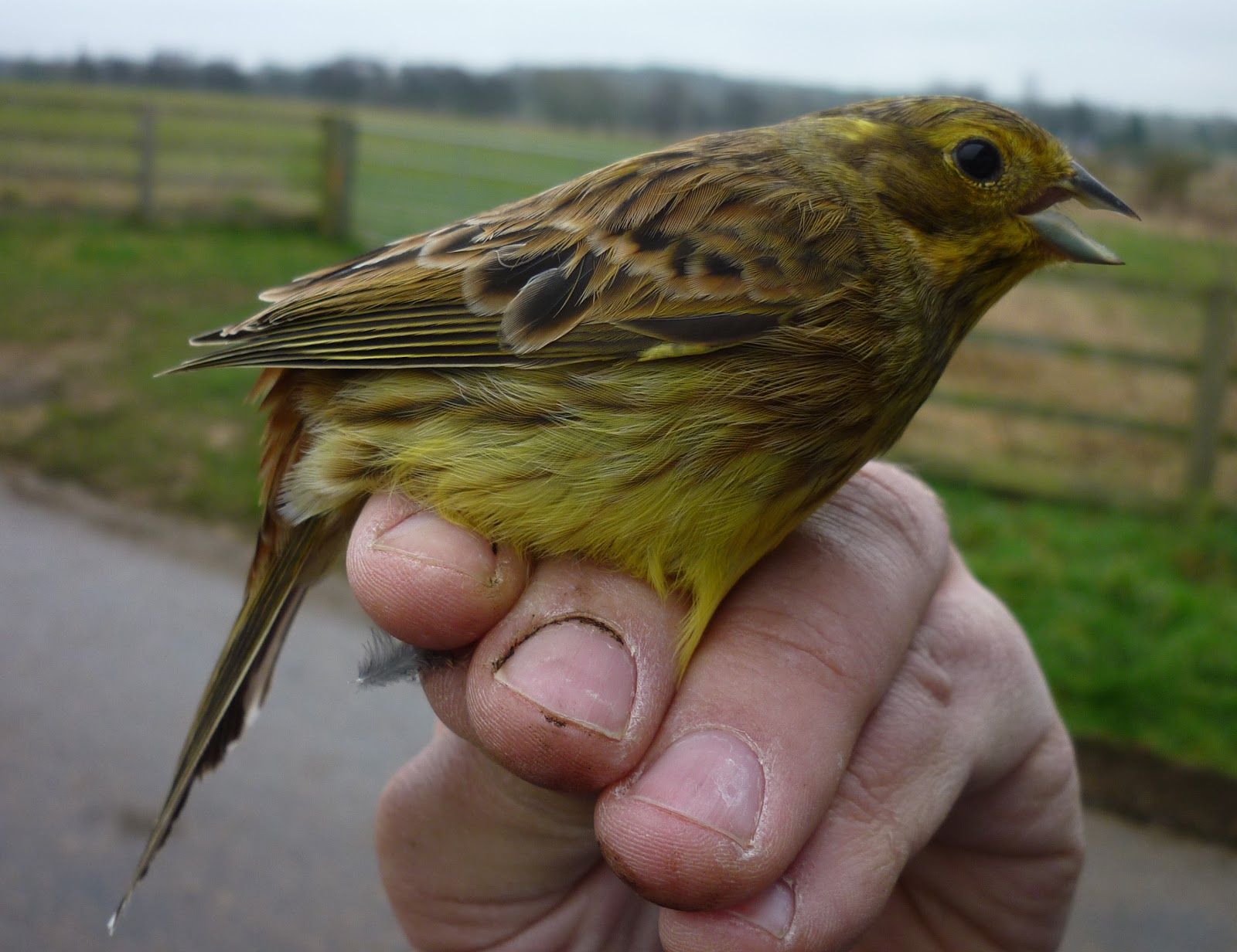
Above: A female Yellowhammer

I have ringed Yellowhammer before (East Yorkshire & Cambridgeshire) but have never caught my own. Yellowhammers have been declining rapidly since the 1980's and may well continue to do so. You can read more about the decline of Yellowhammers on the BTO website here.


Above: A male Lesser Redpoll

I had hoped for a few more of these, but given the milder conditions and location of my nets, this wasn't altogether a surprise.

Above: A Goldfinch

The Goldfinch I had seen before on this site must have dispersed as a lot fewer were seen this time.

Above: A Robin

I'd only seen one Robin here and I saw it collecting nesting material and taking it back to an ivy clad tree. Perhaps this was the one I saw?

Today, the weather has worsened (yet again) so it's chores, chores, chores.... and preparing the equipment for the next ringing session. I have a few pleasant diversions such as remembering yesterdays session, playing the X Box and the England rugby match is on later (though whether this is a pleasant diversion depends on the result!).

Thursday, 31 January 2013

Recoveries

I received an interesting recovery this week involving a female Blackcap ringed at Priory Country Park on 14/09/11 (one of 25 that day). It was controlled at Portland Bill, Dorset on 28th April 2012.

Above: A library picture of a female Blackcap

Looking back at the database for Priory, there have been a number of recoveries involving Blackcaps, but most involve birds caught leaving the country in the South East (e.g. Kent, Icklesham). This is the first recovery of a Priory CP ringed Blackcap caught entering the country on migration (the only feasible explanation for the location and timing), and this is in the South West.

There is clearly a migration pattern going on here, perhaps to do with strategy and or wind direction.

In other news, I caught a control Corn Bunting the other week. It will be interesting to see where that has come from - they are a sedentary species. The BTO online recoveries report shows that there have been no previous recoveries in Bedfordshire (either ringed here and found elsewhere - or vice versa). Up to 2011, there have only been 96 recoveries nationally.


Above: The controlled Corn Bunting


Above: A sunset at Priory Country Park.

Now to get on with catching more birds with other peoples rings on and ring plenty so that other people can catch them! That is, if this wind will calm down....

Tuesday, 22 January 2013

My bird ringing in 2012 - Sandy Smith NR review

Top of the bill (no pun intended) at Sandy Smith Nature Reserve (SSNR) for 2012 has to go to:


Above: Lesser Spotted Woodpecker

It was a year with a number of highlights - 11 new species on the ringing list for SSNR, 3 birds ringed elsewhere caught here and 1 bird ringed here caught elsewhere.

Again, the weather played a part in being able to get out and in breeding success for the birds. Whitethroat, in particular, suffered badly from the rain (as I will show later).

In comparing 2011 and 2012, the overall totals do not give a truthful comparison. Overall, more effort went into ringing SSNR in 2012. This came in the form of longer ringing sessions, one or two more nets at times and as I get more proficient at targeting species, numbers of those species have gone up. As an example, Whitethroat numbers were down in 2012 because of poor breeding but Lesser Redpoll numbers jumped this autumn because I had more success with that species.

Total New: 533 Total Retrap: 469 Overall Total: 1002 New for Year: 621 No. of species: 37

2012 Highlights:

The new species were: Brambling (1), Mistle Thrush (1), Starling (3), Linnet (1), Common Redpoll (1), House Martin (1), Goldcrest (8), Jackdaw (1), Magpie (1), Nuthatch (1) & Lesser Spotted Woodpecker (1).

I won't add photographs of all the new species but here are a few of my favourites:


Above: A House Martin


Above: A Brambling


Above: A Mistle Thrush

The first controlled bird for this site came in February - it was a Chaffinch originally ringed near Little Fen, South Lopham, Norfolk on 23rd May 2010. Next, a Chiffchaff ringed at SSNR in July was controlled in Letchworth in late August.

And then in December, 2 foreign ringed birds turned up (my first foreign ones): a Blackcap with a Strasbourg ring and a week later, a Siskin with a Brussels ring. This data has been submitted to the BTO and I eagerly await the original ringing details.

Above: An adult female Siskin with a Brussels scheme ring on.

I have calculated the amount of effort gone into ringing sessions by counting the hours between first and last capture. This is therefore a minium number as the nets can be up for a while before and after first and last capture.

Total hours in 2012 = 244.25 (38 visits at an average of 6.5 hours per visit) compared to a total in 2011 = 181.25 (36 visits at an average of 5 hours per visit). Fewer new birds were ringed (533) compared to 2011 (693), so the overall total has a greater proportion of retraps.

As for the species:

Apart from Blue and Great Tits that come to the feeding station, Common Whitethroat is the most often ringed species for the site. 2011 was a very good breeding year with 118 birds ringed, but in comparison, 2012 was too wet for them and breeding was largely unsuccessful. Only 6 juveniles were ringed (of 18 new birds) compared to 86 juveniles in 2011 (of 118 new birds). Effort during April to August was 14 visits in 2012 compared to 17 in 2011 so this works out very similar when taking average visit length into account.
More Blackbirds and Song Thrushes were ringed in 2012 as more effort has gone into catching these (apples have worked well).

Despite more effort, fewer Goldfinch have been visiting the feeding station (food has been available on the same basis as 2011).

No Meadow Pipits were caught this year. I did try once, but the conditions weren't ideal. I had two successful attempts in 2011.

No Grasshopper Warblers were ringed this year as none were present in my normal ringing area. At least 2 reeling males were elsewhere on site. 2011 may turn out to have been exceptional as weather conditions in April when they arrived were ideal, whereas 2012 weather was far from ideal. Additionally, some may have, of course, not made it through the winter (where ever they spend it!).

Lastly, longevity records for the site were broken this year. There is nothing spectacular in these and at this stage of the project, it is to be expected. Here are a few selections:

A Great Spotted Woodpecker at 1 year, 348 days.
A Whitethroat at 2 years and 5 days
A Long Tailed Tit at 2 years and 80 days
A Blue Tit at 2 years 26 days
A Great Tit at 2 years 105 days
A Chaffinch at 1 year, 279 days

My first ringing session for the year produced 5 new birds and 5 retraps. A slow start! As I am writing this, I am looking out the window and it is snowing (as it has been all day) so no ringing has been done this weekend). Fingers crossed for next weekend (and the rest of the year!).

Friday, 18 January 2013

My bird ringing in 2012 - Priory CP Review

Well, the weather made it a tough year - and not just for me - for the birds too. Massive amounts of rain over the spring and summer meant breeding was not very successful for most species, but those that could find enough food (Blackbird being one of them) did well. A few planned ringing sessions got cancelled too but I found enough gaps inbetween the wet and windy spells to put more effort in than last year.

The Constant Effort Scheme was operated again (it has been going for 20 years now). Unlike many other people who take part in this scheme across the country, I was among the few who completed all 12 timed visits (plus a couple of extra).

Some effort was put in trying to catch House Martins and Swallows next to the main lake. However, several attempts proved a complete failure. Not a single bird of any species were caught! Unusually low numbers of hirundines (swallows & martins) were passing through on return migration after a poor breeding year and this, along with perhaps choosing a poor site for catching these species, left me scratching my head. There's always next year!

It was my intention to ring at a feeding station during the autumn/winter. New, squirrel proof feeders were required and duly bought. They had been up about a month before they disappeared. It was quite a while before I found 1 and a half of them deep in the brambles. The other 1 1/2 are out there somewhere I'm sure. However, given their disappearance and the cost of replacing them, the feeding station idea was abandoned for this winter.

Total birds handled at Priory CP in 2012 were as follows:

Total New: 640 Total Retrap: 346 Overall total: 986 New for year: 767 No. of species: 33

A species list (along with no.'s of each caught in 2012 can be found on the Priory Country Park page of this blog or by clicking here).

Of special note are the following:

1. A Corn Bunting was ringed (the first at Priory since 3 were caught and ringed in 1991). This was a new species for me and more effort will go into catching this species in the future. Corn Buntings are on the decline and their conservation status in the UK is RED because of a historical decline in numbers and more recently, a breeding population decline. They are hard to catch and I doubt that many have been ringed in Bedfordshire - there has definitely been no recoveries of this species in Bedfordshire as the BTO online ringing reports confirm. However, there will be more about this species in a later post...


Above: A Corn Bunting

2. Only the second Kestrel to be ringed at Priory was caught in 2012. Unusually, the bird was frequenting the area around the ringing site and perching low down in the trees. The first was ringed in 2003.

3. Only the second Jay to be ringed at Priory was caught this year (the first was ringed in 2000). This year was unusual in that there was an 'erruption' or mass migration of Jays across the country. Record numbers were being observed migrating. There is conjecture as to whether these birds are foreign or british ones, however I have read that there is no evidence to support that these were foreign birds.

4. Lesser Redpolls - previously a total of only 9 had been ringed at Prioy before 2012. However, effort has gone into ringing this species and a total of 28 individuals were ringed in 2012. In addition, the first Lesser Redpoll of the year here was a control (i.e. somebody else's ring!). I am eagerly awaiting the original ringing details of this bird.


Above: The controlled Lesser Redpoll

Recoveries:

Blackcap: Ringed in Sept 2011 at Priory, this bird was captured at Grafham Water in May 2012 - presumably it was breeding there.

A Mallard ringed on the Embankment in 2003 was found dead at Priory in March 2012.

Awaiting details of the control Lesser Redpoll.

Details of the controlled Goldcrest from December 2011 came through this year, it was ringed at Flamborough Head (East Yorkshire) in September that year.

Now for the down side - most species didn't manage a good breeding season. I haven't delved too deeply yet into the data as I have a lot of background work to do before I can say anything with confidence, however the totals were down on 2011 for most species. In the wet weather, most species would find their food sources washed off the leaves (e.g.. caterpillars that the Tits feed on) however a few might find more food (e.g. more worms for the Blackbirds).The national preliminary CES results can be found here.

For the first time in 22 years, no Willow Warblers were caught at Priory.

Ringing in Priory Country Park has started for 2013. News will be posted in due course. Here's to a good year (he writes as it snows!).

Wednesday, 16 January 2013

A Falconry Day

In between Christmas and New Year, I spent a gift voucher given to me for an 'activity day' flying birds of prey at The Falconry Centre at Shuttleworth (Old Warden) in Bedfordshire.
I got fly a number of species and see some others close up (sat on my gloved hand). The day started with some owls.


Above: This is a Scops owl called Shaun.


Above: This is a Carribean Barn Owl called Lunar (different from our Barn Owls in that ours are white on the front).


Above: Then came a BIG Bald Headed Eagle.

We flew a Kestrel and a Harris Hawk before lunch. After lunch we flew the Bald Headed Eagle and ...


Above: A Chilean Eagle.

We also flew 2 Harris Hawks from tree to tree. The nicest of the 2 was Rolo (yes, named after the chocolate). A small drama ensued when one of them, after landing on the ground, decided to perch on the shoulder, and then head, of one of the ladies who had also come along for the day. It was quite comical in the end and no harm was done to the bird or the lady.


Above: Before we left, we got a short talk about this Andean Condor. We got to hold a few Eagle Owls and finally - quite possibly the best bird of the day -


Above: A Lanner Falcon.

An enjoyable day. I can see the appeal in being a falconer, but for me, I would want to do as a hobby for my own pleasure and not as a job and that doesn't seem right to me. I'll be leaving Falconry to other people.

I do prefer the wild birds more!

Wednesday, 26 December 2012

Did I reach my target?

Oh, yes I did ...
Oh, no I didn't ...
But which is it?

I'm in Gloucester now until the end of the year. Depending on the weather at my Dad's house, I might get some ringing in - there are 4 Blackbirds hanging around daily on the patio, each with a ring on (more than likely mine) as well as Dunnocks, Coal Tits and plenty of Blue Tits (no change there then!). Having done all the ringing I am going to do this year in Bedfordshire, it's time to do a final check on totals.

The final count for Priory Country Park this year was 986 handlings. The weather (mainly) and other commitments meant I didn't make a final attempt to catch the extra 14 birds I would need to make it 1000 for the year. Having caught over 1400 last year, I'm not so fussed.

As you may have read previously, my totals at Sandy Smith Nature Reserve (SSNR) have been subject to much fretting over whether I would make 1000 or not. Last year, I reached 999 handlings. One more hour (or less) of effort in 2011 and I wouldn't have been thinking twice about my totals for this year, but as somebody pointed out I had failed (in jest, of course), I had to make sure of 1000 this year.

In my last post, I wasn't sure if I would make it. Decent catch totals in November and early December were making the target achievable, but totals suddenly dropped off after the cold snap melted and the rains returned. The luck that brought a foreign control Blackcap one weekend and a foreign control Siskin the next (with 70+ other birds), deserted me.

Heavy rain and strong winds stopped ringing activities on at least one day each weekend. So on Friday 21st, with a forecast of heavy rain for the weekend and parents demanding my return to Gloucester ASAP, I decided to take the day off work and set my nets. Come what may, at the end of the day, the likelihood was that if I hadn't reached 1000 handlings, that would be it. Being 25 birds short, I figured that it was possible (30 was the total on the previous weekend).

Liz, the Greensand Trust ranger for the site made an unexpected visit and gave me some encouragement!


Above: Shortly afterward Liz's visit (I say shortly but in ringing terms, 2 hours + is a long time if you're not catching many birds) I caught this Great Spotted Woodpecker. Handling no. 1000 in 2012 for SSNR.


Above: The entry on my data sheet. Bird no. 25 for the day = 1000 for the year.

I made it! Now for some well earned rest (and the inevitable cold that comes when you stop). Merry Christmas to you all. I hope you have a good New Year.